2018-08-26

Beavertown Sapling IPA

On the one hand: oh dear, another Beavertown special. If only I still used ratebeer I could look it up and see what it is. Nice graphics tho.

 And on the other: 65 IBUs? Yep, I'll take one ta! And hey, it's Beavertown - gotta be good, right?

Cracking open the can I can smell the smell that means lots of bitter hops - but what is it? Resinous? Green? Dank? (However nebulous a descriptor that last one is)

So. It's not particularly fruity. Perhaps some yellow citrus notes. Not too tart. There's a fresh white wood thing. A peeled stick maybe? Or is that just me channelling the cool label?

There is a smell I can only describe as bitter. Clearly, this ain't a smell according to the current model of human olfaction, so I must be smelling some hard to verbalise aroma which I generally associated with bittering hops.

Pouring out the last of the can I'm sooking (or "huffing", if you like) the very final dregs trapped behind the lip of the opening. As always, this creates a fine aerosol or mist of what is—at least in this sort of beer—the very essence of the bitterness.

If you haven't done this before you really should (but go and get a properly hoppy can to do it with). It highlights a particular aspect of the beer in a way you don't otherwise experience. As when rubbing heavily peated malt whisky onto your hands to find the cereal behind the peat, or misting your tongue with brandy from an atomiser spray, it's good to explore flavour from odd angles occasionally.

In the particular case of Sapling, the huff reveals a powerfully bitter dry earthy sandiness behind which there is sweet yellow fruit juice, although not orange. Perhaps it's one of those odd mixtures of banana, apple, and a token gesture's worth of pineapple. I think I mean 'smoothie'.

I'm still not getting very close to what the bitter-associated smell is. Let's just leave it at "bitter" and ask the smell scientists to revamp their model to fit.

The taste is satisfyingly dry. There is a juiciness and a persistent bitter hoppiness which dries things out nicely.

A lemonade note. Metallic hops. Ripe yellow fruit - perhaps tropical.

This is a very, very fine beer, and especially in its 65 IBUs - the best kind of bitter.

I have but two complaints. The first is that 330ml is not quite enough, even at a strength of 7.1%. 500ml would perhaps be excessive, but 440 is a pleasant number. The second is that the ABV is entirely deceptive. Only in the thick texture is there any indication that the alcohol is higher than normal.

In conclusion, well done to Beavertown, good work. And, by way of a post script, it occurred to me some time after I'd written my notes on this beer that maybe the name is quite apt, since it reminds me of peeled green sticks. Or perhaps not.

2018-08-21

Little Pomona C'est Si Bon-Bonne

My first thought is that the tannins are beautiful. Present, prominent, yet in no way abrasive. They curl round your tongue and in behind your teeth like a cat settling on your shoulders; it's lovely but if it it weren't lovely the cat wouldn't care and would still do it. Purring, rounded, but irresistible.

Then there's a metallic, earthy note, which isn't quite iron. Is this bottling perhaps slightly less clean than other Little Pomonas? After all, relinquishing control of the maturation of a cider to an oak barrel, however carefully sourced, however thoroughly the bunghole has been sniffed, is always something of a risk.

Peach pits. And a rather pleasant acidity.

They're definitely mineralic, these tannins. Almost blue steel (as when one has made steel tough by heating it, perhaps by drilling it at too high a speed or without lubricants).

It seems to me tonight that of all the Little Pomonas this is the one where tannic structure is most important.

From memory I think I can dismiss The Rainbow and The Unicorn as flighty creatures of fruit.

The Old Man and the Bee had a ripe richness which dominated other aspects of its character. Feat of Clay was brighter and sunnier - youthful choirboys beautifully chanting psalms rather than the Mongolian throat songs of Bonbonne.

If this were wine I'd call these tannins chalky. Can I do that with cider?

Blue steel.

It's too full bodied to compare with Chablis, and there are these compelling tannins. But the blue steel.

It stays with you. The tannins don't want to leave. Like Secret Service agents, inexorably polite, Ma'am-ing to left and right and not moving no matter what you say.

Behind all that tannic action, there's something which might be fruit cake or dried apricots.

Here, tonight, this is the best cider I've yet tasted from Little Pomona, and I think it's a strong contender for my cider of the year. You should seek it out and try it.

(Now, quite clearly I'm not in any way impartial. The owners and makers of Little Pomona are very dear friends of mine, and I've helped out at every harvest since 2014. But that aside, I do think this is an exceptional bottle of cider)

Boring technical stuff: C'est Si Bon-Bonne is a dry, still cider from Herefordshire. It's made mainly from Dabinett, along with Harry Masters Jersey, Ellis Bitter, and Foxwhelp (I helped pick and press these last two). It was a wild ferment in an ex bourbon barrel, left for six months then racked into glass bonbonnes and aged without oxygen for a year.

You can read more about Little Pomona here.


2018-07-24

Pilton Ice

Is it just me, or does everybody think of the Piltdown Man when they see a bottle of Pilton? Just me? Right. Fair enough.


This empty bottle held a most rare, and most tasty, liquid. Britain doesn't have the right climate to permit cider makers to make ice cider al fresco, so there's a good deal of faffing about with chest freezers, not to mention the difficulty of pressing frozen apples, or, as has happened in this case, the freezing and slow careful thawing of already pressed juice. The result is delightful.

(I should say, by the way, that this tasting note was written at a point when the bottle had been open a few days)

Colour is a vivid red amber. Not quite copper. Vivid and beautiful.

The nose is very earthy. It seems tannic  - so I guess it's making me think of apple skins. Mossy sticks. Spices and apple skins. Herbal? Aye, herbal, green-grey, lichen on stones . It's a fascinating herbiness. Grey-green, but not as sweet as sage.

The taste is tangy sweet, but with drying tannins. Earthy again. Vivid fruit acidity. Red fruits. Dark. Not yellow. Perhaps some green gooseberry acid. The tannins are very gentle. There's some bitterness in the finish, but it serves to balance the intense sweet attack. A delicious, complex drink.

I'd class it as Outstanding. Can I have some more please?

2018-07-18

Tannins of Wood and Skin

I've thought about it every time I opened the cupboard and saw the can looking at me (and it's been in there for a solid month and a half). I can't escape the feeling that I'm missing some sort of cultural reference or in joke or something. I've googled 'BAE' and think I have a handle on that, but then, a badly formed search term can throw one off the scent forever.

Despite all that, I'm reasonably confident that I can still assess this beer fairly. If not, well, oh dear, how sad, never mind.

So, what I'm drinking is a Sour Ale with Pinot Noir grapes, aged in French Oak. I don't know anything about Stillwater Artisanal except that they're American (and that only because of the label).

This is a beer not heavily carbonated - although the style doesn't seem to lend itself to a good head. (Note to self: Investigate relationship between pH, acidity, brewing adjuncts, and head formation / retention) It has an attractive red-amber colour with an interesting (and, to me at least, unusual) gold rim.

The nose starts off with the sort of grubby, earthy sweetness that French oak so often gives to beer or whisky (something to do with malt perhaps?). Then there's the flat sweet note of sour beer, and something a bit straw-like - akin to a cider, but not as sweet.

The palate has a sherbet-y acidity. Perhaps it's a combination of oak sweetness with kettle souring but it seems more sweetie-like than many sours.

(NB! I'm assuming this is a kettle sour, purely on the basis that it lacks the depth of a koelschip/lambic style beer)

There's less tannin than I'd expect given the Pinot Noir grapes and French oak, although now that I've mentioned Pinot, I can indeed taste red fruit. And perhaps the tannins of wood and skin are coming through in the bitter finish this beer has. Or perhaps not.

The red fruit notes are really quite generic - there's not a specific fruit I can pick out.

I would rate this beer as Good. It's more interesting than most kettle sours, but then they have thrown Pinot grapes and French oak at it, so one would expect some complexity.

I'm still not sure what to think about the name. I suppose brewers produce so many different brews that after a while it must be difficult to think of new names. Certainly, it's no sillier than, say, Disco Forklift Truck. I suspect it comes back to my original point -  I feel that I'm not in on the joke.

2018-05-03

I Might Change My Name To Hendre Huffcap

My very good friends TallAsAVan and DrinkBritain kindly gave us this bottle last Christmas. They said that it was something rather special, so when the Prodigal Wean came up the road for a few days that seemed like a good occasion to open it.

I could tell straight away that it was something out of the ordinary. The muzzle took nine half twists to remove. Nine, I tell ye! And take a look at that picture. Have you ever seen such a nubbly little cork, even on a bottle of gueuze?


The three varieties of perry pear used for this bottling are Antricotin, Rock, and Hendre Huffcap. Gotta love perry, just for the fruit variety names! 

To start with I was a wee bit concerned that it seemed very bretty but that cleared off pretty quickly, so maybe it was just bottle stink.

The nose was very complex, and quite intense. There was pear and elderflower, mossy sticks, a touch of what might have been spicy honey, plus fresh silage or cheesy straw. Inexplicably, the overall effect reminded me of stir fry. The Prodigal Wean liked it too - she suggested, "the fresh greenness of spring onions without the onionyness", and, "ginger?”.


The palate was light and airy (one of the things I  love about good perry - that it can be so light and yet also intense). It tasted of green apple skins, more of the green sticks from the nose, a touch of clean dark earth, and honeyed pear juice. 

And just to wrap it all up, there was such a lovely clean finish. Pretty much everything about this bottle was perfect.

So thank you DrinkBritain & TallAsAVan for the gift, and thanks Wean, for that spring onion tasting note. 

2017-09-21

Things Not To Do With A Pineapple

That Boutique-y, the hydra-headed bottling offshoot of Master of Malt, produce some very fine drinks. Indeed, I was lucky enough to attend a tasting hosted by the estimable and very congenial Dave Worthington earlier this summer where he let us try a two decades old Tormore which was quite the best expression I've ever had from that distillery.

However, their approach is somewhat scattershot. And whilst an open mind and a willingness to experiment is to be commended, I'd respectfully suggest that some things might be better left unbottled.

As witness this oddity, That Boutique-y Gin Company Spit-Roasted Pineapple Gin Batch 2.


According to the accompanying press release, during the second Golden Age of the Cocktail fruit gins were all the rage. But then, and again according to the press release, the second Golden Age of the Cocktail was the 1950s-1960s, an era which also gave us whiskey flavoured toothpaste and jellied salads. Which makes their judgement in matters of taste suspect, wouldn't you say?


The nose is certainly very pineapple-y. Not fresh pineapple, but the juice, from a carton, or perhaps the syrup from a tin. Hang on though, where's the juniper? Seriously, there's no juniper.

The palate is suprising. It's very thick, sweet, syrupy, and sticky. I'm reminded (although I'm pretty sure it's a false memory) of an old liqueur that's been at the back of the drinks cupboard for years, perhaps a dodgy knock-off Benedictine clone, or a not very orange-y Cointreau-alike. I suppose the faux-Benedictine memory must be the gin botanicals.

In conclusion, bleh. If this had a clear gin character, or fresher pineapple notes, then maybe. But as it is, bleh.

Rereading the blurb, I see that pineapple gin was supposedly also popular in the 1920s. Which means that after this batch of 3300 bottles is done, we ought not to see any more until the 2060s. Fingers crossed.

2017-09-12

Sweet Wine Wednesday - Aged Sauvignon Blancs

Sweet Wine Wednesday, a Glasgow-based wine trade tasting group, has been on the go, sporadically, for nigh on ten years, and for most of that time it's been a running joke that one of us would threaten to bring along his vertical of aged Marlborough Sauvignon Blanc.

Well, it finally happened, and it was a delightful surprise. (I hesitated over my choice of adjective there. Really, I need a word which means delightful with a touch of astonishment)


We tasted three vintages of Villa Maria Clifford Bay Sauvignon Blanc, the 2001, 2002, and 2003. The oldest of these was bottled under cork.

All three were in very good condition, very clean and lively, with plenty of fruit still showing. I'd say that the ripe tropical notes of a fresh Kiwi Sauv had diminished in all of them, and green flavours were much more to the fore. "Peas and asparagus" is a bit of a Sauvignon Blanc cliché, but it was very applicable here.

For me, the 2002 was the most tart, and I found plenty of gooseberry notes, as well as an intriguing green chilli aroma. The 2003 rather reminded us of Riesling, in that it seemed to have a mineralic or petrol note, and a distinctly sherbet-like palate.

But the real revelation, and my favourite, was the 2001, the last vintage of this wine to be bottled under cork. There was a richness to it, a creaminess, which I've never encountered in a Sauvignon Blanc before. It reminded me of rice pudding or lemon cream. It was wonderful.

I can't quite credit that I'm actually writing this down, but the conclusion that we took away from this tasting was that we ought to lay down some Awatere Valley Sauvignon Blanc, with a label tied to the necks saying, "Not to be drunk before 2030".

What I can credit, and say most firmly, is that New Zealand winemakers, and Villa Maria in particular, have risen considerably in my estimation. Whilst I've always known that they are experts in capturing the fresh fruit flavours of wine to be drunk young, I never entertained the notion that these sorts of wine could be in it for the long haul. Until now....

2017-09-09

A note on Nicolas François Billecart 2002

I hosted a champagne tasting last night, with wines from Pierre Peters, Fleury Père et Fils, Palmer & Cie, Moutard, and Billecart-Salmon.

It was my first tasting of a Pierre Peters wine, in this case the Cuvée de Reserve Blanc de Blancs Grand Cru, and rather disappointingly I didn't really understand the wine, although I suppose that's an excuse for another bottle.

But that's not the main thing I wanted to say. I've tasted the 2002 Nicolas François three times now; in 2015, last year, and last night. The first of these was in ideal conditions, and the wine, while clearly still very youthful and tightly wound, also managed to be reasonably expressive. Last year's bottle was completely unexpressive, so I was a little apprehensive about opening it again last night, but I have rather done Krug and Dom Pom to death over the last twelve months, so Billy it was.

And I'm so glad I did. It was beautifully expressive. Lean, yes, tight, indeed, but it had such lovely aromas of white flowers, and there was a slight saline edge to it which I hadn't seen before. It was the wine of the night by a country mile, and I look forward very much to tasting it again in another year's time.


2017-09-03

Tasting Notes: Some Things To Read

This post gathers up some links to articles (and one or two books) I've read which have some bearing on the matter of Tasting Notes, and which I've found useful. I then give a brief summary of Peynaud's classification of types of tasting, and finish with a quote from the master.

I ended up in the booze trade by accident, and stayed because I found it congenial. Over the years my particular interest has shifted from topic to topic, region to region, but whatever my current obsession I've always been very keen on writing tasting notes. It's not the easiest habit to acquire, and the craft of writing good tasting notes isn't learned overnight. Indeed, after sixteen years I'm still trying to improve my tasting ability.

A good starting point for writing tasting notes is the Wine & Spirits Education Trust Systematic Approach to Tasting. It imposes a structure and vocabulary which is very helpful when one is just setting out on the tasting journey.

The Taste of Wine, by Émile Peynaud, whilst perhaps a little dated in places, remains the foundational text for tasters. It introduced me to many useful tasting exercises, and is beautifully written too.

Having read The Taste of Wine, it is useful to then read Classification and hierarchy in the discourse of wine: Émile Peynaud’s The Taste of Wine, by Nigel Bruce. This is an analysis of Peynaud's book from (I think) an anthropological point of view. Reading this probably won't make you a better taster, but it will certainly make you think more deeply about Peynaud.

Next, a couple of short pieces by Andrew Jefford, plus a slightly longer one from Bianca Bosker. These all address the perceived shortcomings in present day tasting notes, and suggest a few ways to improve your notes.

http://www.decanter.com/learn/how-to/how-to-write-wine-tasting-notes-272531/

http://www.decanter.com/wine-news/opinion/jefford-on-monday/jefford-on-monday-tasting-notes-the-shame-of-the-wine-world-272488/

http://www.newyorker.com/culture/culture-desk/is-there-a-better-way-to-talk-about-wine

Lastly I must mention Gordon Shepherd's books Neurogastronomy and Neuroenology. Reading them has given me a much better understanding of the workings of the human sense of smell.


Some notes derived from The Taste of Wine, Emile Peynaud 
All tasting can be classed as either:
  • hedonic – purely for pleasure
  • analytical – tasting done with some professional or commercial aim in mind 
It is important to be clear in advance what is the purpose of an analytical tasting, as otherwise the results may not be useful.

Peynaud divides analytical tasting into three types:

Descriptive tasting – studying, identifying, and listing all of one's sensory reactions to a drink, and explaining them as far as possible according to the raw materials and production methods of the drink. One important part of descriptive tasting is the use of a precise vocabulary, which is understood by other professional tasters.

Differentiation between & identification of samples – necessary for comparisons between eg different drink recipes, or when making a choice between two similar products. Often done 'blind', so as to minimise preconceptions. This type of analytical tasting often leads into:

Appraisal and quality ranking – assessing a product in terms of commercial quality, for example in choosing which of two rums to stock, or in tasting a range of one product type at a trade show

All analytical tasting is a form of comparison (even when only tasting one sample – in this case, one is comparing with memories of previous similar products), but none of the three types of analysis listed above includes personal preference. The key thing in becoming a good analytical taster is to set aside one's likes and dislikes, at least until after the analysis is done.

Tasting accurately is a skill which can only be acquired with regular practise, and all tasters will have good and bad tasting days. The following quote (about blind tasting) sums it up nicely

...all of us go through some periods that are better than others, during which we can be remarkably successful at blind tasting. I know of tasters who live by a reputation forged on two or three inspired guesses. I myself have experienced moments of glory when everything seemed obvious to me, and I have also drunk the cup of humility to the dregs when, unable to interpret any clue at all, I have ended up making enormous blunders. Blind tasting is one of the finest schools for teaching modesty

2017-06-14

Domaine Trimbach: Some Wines

To the capital city and to Good Brothers for a tasting with Julien Trimbach, the young man who will one day be the 13th generation winemaker at Domaine Trimbach, one of the best Alsace producers (top three, I'd say). He's a remarkably accomplished speaker, and had some very interesting things to say.

I've never heard another winemaker (or perhaps I should say apprentice winemaker) talk so much about the taste of soil. Perhaps that reflects the diversity of soil types in Alsace, which range from granite, to limestone, to iron-rich soils, and even volcanic to a kind of crumbled granite called grés de Vosges.

We tasted through eleven wines taken from the currently available range, plus a beautiful Pinot Gris from 1990. The house style is decidedly dry, which suits my palate very well.

Riesling Réserve 2014
The grapes for this cuvee are harvested from several different soil types and vineyards, but M Trimbach described it as having a "limestone nose". It's a zingy, fresh wine, with intense lime and grapefruit aromas and a long lasting citric acidity. Delicious.

Riesling Sélection de Vielles Vignes 2012
Described by M. Trimbach as "a classic vintage", he also told us that for this vintage 80% of the fruit is from the Vorderer-Haguenau vineyard, from vines over 80yo. At 4.5 grams per litre of residual sugar it's still a dry wine, but definitely softer than the Reserve. I found a beautiful waxy note on both the nose and palate, and the citrus fruit elements were so ripe they seemed almost tropical.

Cuvée Frédéric Emile 2008
Trimbach are famous for their refusal to use the Alsatian Grand Cru designations on their labels (although that is changing now), and Freddy Emile is in fact a blend of Riesling from two different Grand Cru vineyards, so they wouldn't be allowed to label it as such. That doesn't stop it being a fabulous drop. Where the Vielles Vignes was showing spicy notes, this has evolved into savouriness, while still showing the intense citrus fruit of the younger wines. The texture was wonderfully buttery too.

Clos Sainte Hune 2008
M. Trimbach had stressed that the company likes to hold back wines until they are ready for release, but I guess that's not feasible in this case. Even López de Heredia in Rioja don't wait a quarter century to release Vina Tondonia. And that's the sort of time to mature that I think this wine probably needs.

The Clos Ste Hune is a lieu dit within the Rosacker Grand Cru in Hunawihr. There are just 1.67 hectares of sixty year old Riesling vines, yielding a mere 10,000 bottles annually, on average. Clos Ste Hune's soil is a kind of shell filled limestone called muschelkalk, which is the kind of uniquely Alsatian word which illustrates the mixed Franco-German heritage of the region nicely.

The nose showed petrol and a leafiness - not quite leaf mold, but old leaves. There was also a silky, creamy, mineralic whiteness, as if I were smelling white chocolate, but sans vanilla, or some sort of very rich white flowery perfume.

The palate was soft, rounded, and intense, but very, very tight. It was very well balanced, with a dominant flavour of lime. Of all the wines, this was the only one which seemed warm in the finish. To me, it was on the same level of quality as the other wines I tasted, which I'm inclined to attribute to its relative youth.

Pinot Gris Réserve 2014
Described as "Pinot d'expression", I found this to be very savoury and spicy, indeed almost meaty. I found chestnuts on the nose, which I've never seen in a wine before. The palate was much more about fruit, with green apples and grapefruit, plus a leafier version of the spices from the nose.

Pinot Gris Réserve Personelle 2013
Made with grapes from the Grand Cru of Osterberg, this wine was rather gentler than the 2014, and there was more fruit on the nose; ripe, honeyed yellow apples, even a touch of banana. The palate was sweet and rich, with a lovely soft lemon sherbet finish.

Gewurztraminer Réserve 2011
Less intense than the previous wines, this showed classic Gewurz notes of rose, lychee, and/or turkish delight (take your pick. Or we could just agree to use Gewurztraminer as a descriptor). The palate was very easy going, with a tasty background note of dry savoury spice which somehow made me think of suede.

Gewurztraminer Cuvée des Seigneurs de Ribeaupierre 2011
Drawn from two Grand Cru vineyards, Altenberg Mandelberg, this wine smelt more spicy than the Reserve, but had less of the floral elements. The palate was riper, too, with the fruit veering into mango territory and a lovely broad mid-toned spiciness.

Pinot Noir Réserve 2015
This was a surprise - a tasty surprise. From a dry vintage, and made "without oak" (actually 80 hectolitre very old oak tanks), it was juicy, fruity, clean, and utterly gluggable. Or, as M. Trimbach more elegantly put it, "not an intellectual wine". The nose was cherry syrup, the palate was redcurrants. Lightly chilled on a warm day, this would be gone in twenty minutes.

Pinot Gris Vendanges Tardives 2008
This wine perhaps whould have been aired for a little longer, as it initially showed that hint of cabbage which occasionally appears in old whites. With time it developed concentrated buttery and mossy notes. The palate was sweet, with butter orange peel, some green lime notes, and a surprisingly light body for a VT.

Gewurztraminer Vendages Tardives 2014
This was described as being a "difficult vintage".

A nose of ripe roses and powdered ginger, which evolved over time to show some leafiness and a slight mushroom character. The palate was very fresh, light, and completely unsticky - brilliant acidity. I found flavours of ripe yellow apples and honey.

Pinot Gris Vendanges Tardives 1990
A wee treat from the cellar to finish off. If you made a plate of wholemeal toast with lashings of butter and runny honey, and then took away the toast, then you'd have the nose of this wine – except of course that buttered toast is never really elegant, and the wine was so very elegant.

The palate was soft and elegantly glamorous, with plenty of acidity to suggest that the vintage will evolve for many years to come. It was much, much sweeter than the other VTs, and had a glorious complex spiciness which might have been cedar wood.


2017-05-09

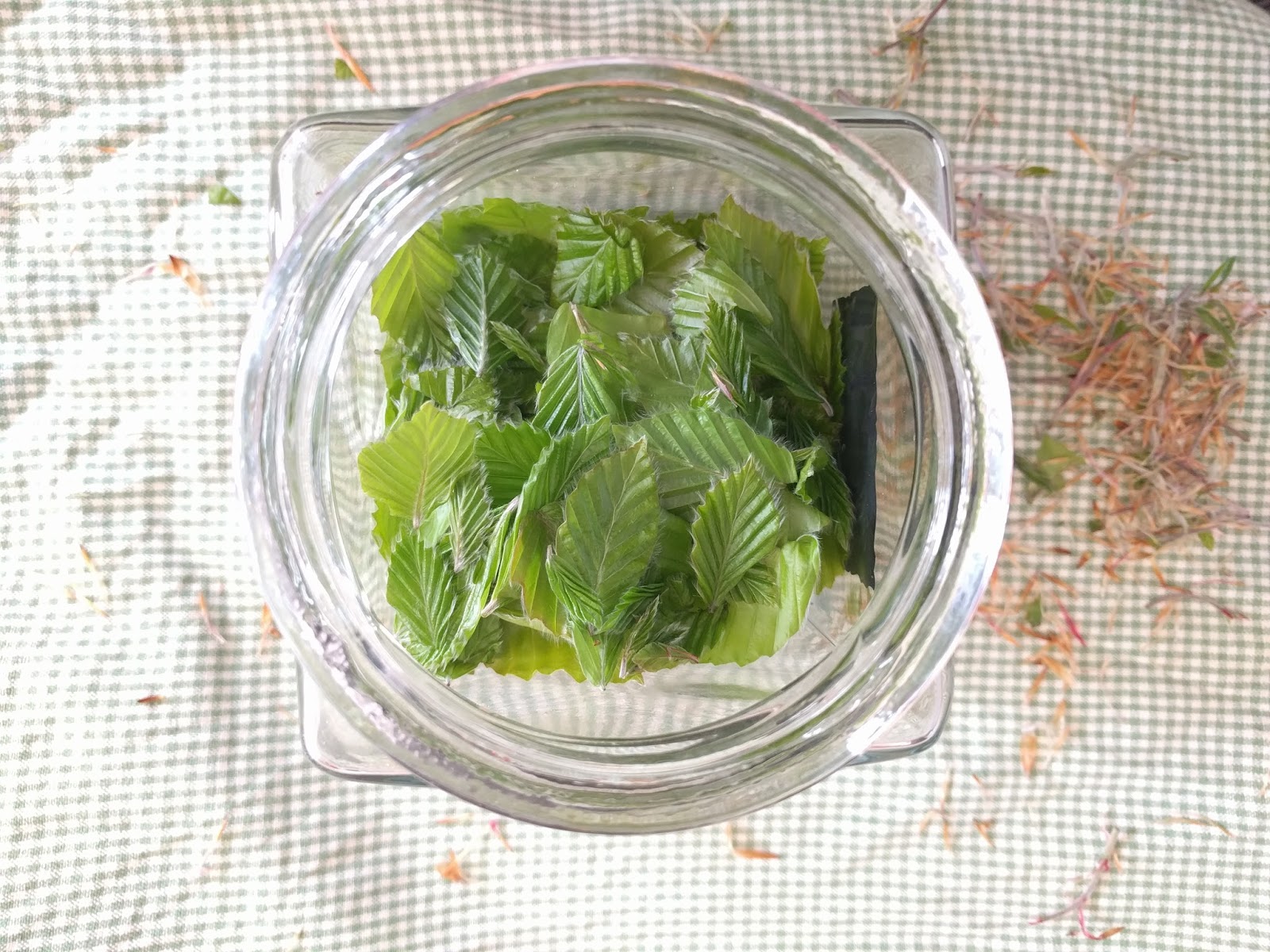
Beech Leaf Gin

Yesterday was a beautiful sunny day, so I picked a load of freshly budded beech leaves and put them in a glass jar with a litre of gin dregs.

It must be seven or eight years since I last made noyau, but I was inspired to have another go by @_littlebrowndog, a fellow member of the whisky world who is also responsible for the fascinating #projectPEAT.

The discarded scraps of bud. Very fiddly.
In the past I've not managed to catch the leaves at quite the earliest stage, but this time I was able to select the freshly budded leaves, many of which still had the wispy pink bud covering. This made preparing the leaves rather fiddly, but they were so soft (and importantly, not at all waxy) that the process of extracting flavour is sure to be much faster.

The gin dregs were selected from about forty different gins on the simple basis of whether on not I consider them to be any good. So the bland, the odd, and those with any off notes were rejected. It does mean that there are rather a lot of botanicals competing with the fagus silvestris, but it's so long since I've made noyau that everthing about the process is once again experimental.

I'll update this blog post in a wee while (a few days, a few weeks? Not sure yet) once I reckon the gin is sufficiently green (although I seem to remember it's more of a yellow than green).
       
Freshly picked leaves
Leaves, jar, but no gin.

2017-04-05

My Big Book of Grapes

A few years back I received the wonderful gift of Wine Grapes : A Complete Guide to 1,368 Vine Varieties, including their Origins and Flavours, by Jancis Robinson, Julia Harding, and José Vouillamoz.

It came in very handy last night on tasting this Lyrarakis Psarades Dafni 2015. It was by far the most unusual wine I have tasted in the last I don't know how many months. Just look at my tasting note:

Nose: Vermouth, bay leaves, herbs. slightly sherried. A green, nutty note.

Palate: Dry, mid- bodied, mid acidity, mid alcohol. Herbal, green, bay leaves. Very very distinctive, unusual, delicious.

No kidding, this wine tasted remarkably like Noilly Prat. It was delicious.

So anyway, turning to Wine Grapes I learned that Dafni is a variety from the Greek island of Kríti (aka Crete), which had all but disappeared by the end of the 1980s. Fortunately, Lyrarakis, the producers of this lovely wine, continued to cultivate it, and is now back up to around 15 hectares. It seems that it needs to be intensively pruned for low yields in order to give these lovely flavours, which is perhaps why it fell out of favour.

I'm so glad it survived. I don't suppose I'd want to drink it all the time, but for a food-friendly change of style it's just about perfect.

If you don't yet have a copy of Wine Grapes, I cannot recommend it highly enough. It's worth it for the pedigree charts alone. Here's a not very good picture of the entry for Dafni:

2017-02-17

Tasting Note: If Savoury Frangipane Were A Thing

To be honest, I only wrote this tasting note because I wanted to use the title. That aside, I'm enjoying a great glass of wine.

Vajra is an absolutely top notch producer of wines in Piemonte, Italy. This bottle is from an estate that Vajra bought towards the end of the 2000s. It's Luigi Baudana Dragon 2015, a fantastic blend of 50% Chardonnay, 30% Sauvignon Blanc, 15% Riesling and 5% Nascetta (whatever the heck that is).

My tasting note:

Nose:  Complex, nutty, and herbal, with a suggestion of something phenolic (or terpenes?) possibly analogous to the petrol note in Riesling. If savoury frangipane were a thing, this is how it would smell.

Palate: Complex, rounded, and delicious. The acidity is somewhere between lemon juice and grapefruit pith. Green notes are less in evidence than on the nose. There's something of the phat of a brazil nut. A very clean refreshing finish. Nothing of the individual grape varieties, but that is absolutely not a criticism.

Conclusion: This is superb wine, and awfully cheap for what it offers. Also, it has a dragon on the label.

2017-01-15

Dom Pérignon


One of the many benefits of working in the booze industry is the quality of the drinks on a staff night out. Our latest expedition began by setting a fairly high bar, with a mini Dom Pom vertical, of the 2006, 1999, and 1982.

(It's interesting to note, by the way, that Dom Pérignon these days doesn't mention Moët et Chandon on the label - perhaps they feel it makes the brand seem more exclusive?)

The 2006, in its first plénitude, was big and bold: fresh icing sugar, sharp floral aromas, but also with a touch of mushroom. The palate was soft, sherbety, with lemon notes and a beautiful rounded flowery character. The finish was noticeably drier than on the other two wines.

The 1999—not a stellar year, but, by my calculation and triangulation based on what the DP website says, in its second plénitude—wasn't any better (in the hedonic sense) than the 2006. Indeed, I think I enjoyed it a notch less. But the flavours were quite different. The nose was both spicy and mineral laden. After a while a floral component rather like that in the 2006 appeared. The palate was intensely mineralic, tangy and grapefruity. It was also richly floral—roses I think—with the richness extending to ripe fruit.

The 34 year old wine, almost but not quite flat and a deep, deep gold, was something else. Well into its third plénitude, this was a glorious glass of fizz. The nose had some of the floral elements present in the 2006 and 1999, but ah!, the rest of it. Runny honey on toast, sweet roasted almonds, buttery caramel, and a shining warmth. Liquid sunshine indeed. The palate showed the slightest spritz, and a fair bit of oxidation (good oxidation, like Madeira), despite which there was still a very decent level of acidity. The flavours were all sorts of fruit: juicy and fresh berries, raisins, figs, lemons. Just delightful.

The Dom Pérignon 1982 wasn't the oldest wine we tasted tonight, but for me it was far and away the finest. I'm usually more of a Billecart fanboy, but if all DP was this good...

2016-11-11

Needs More Juniper

I'm currently working my way through four dozen gin samples for the World Drinks Awards, a process which was delayed by an absolute stinker of a cold (necessitating a rather busier than anticipated weekend ahead).


Oddly, and despite the name being a bit of a clue as to what the drink should taste like, some of these gins need more juniper.

Or perhaps it's not odd. Perhaps, in the current crowded market of new gins, some poor sods have decided that their USP is going to be Lack Of Juniper. Who knows?

Incidentally, I reckon we have just hit Peak Gin. How do I know this? Well, on the Archers, Toby Fairbrother is trying his hand (and failing) at gin distilling.

2016-09-11

Classier Than Your Average Pocket Rocket

I bought this a while back, not really knowing what it was. Well obviously, it's Mural do Favaios, a fortified non-vintage Moscatel from the Douro, but why is it in this tiny crown capped bottle?

It sat around, not being drunk (for want of a suitable occasion), until tonight, when I had a sudden eureka moment - it's a pocket rocket! Which is to say, a small, strong, readily consumed slug of booze, in a handy, easily concealed format.

Having figured it out, and knowing I'd never use it as intended, there was nothing else to do but drink it. Which I did. Here are my observations.

Nose: faintly reminiscent of oloroso sherry. Or tawny port. Or somewhere in between. Toffee, and a hint of struck match.

Palate: 17%? Really? Actually, there is a bit of heat in the finish, but the attack and mid palate are very light. Watery, if one could have sticky water. For sticky it is, in a pleasant toffee apple fashion.

Conclusion: It's very simple, but it's also rather direct and to the point, the point being a strong wee sweetie. I sort of wish I'd bought two...

2016-04-16

Tasting Note: Chassenay d'Arce Pinot Blanc 2006


Nose: yellow fruit. Clean and fresh. Nothing to say that it's a ten year old wine. Tangy. Citrus and pineapples. Under-ripe honeydew melon rind.

Palate: there is some evolution, but it still feels pretty fresh. Very tangy and tart. Real yellow fruit character, along with a light body.

Conclusion: this is a lovely wine, and distinctively different - I've never encountered that pineapple note in any other champagne. And, as with many wines from the Côte de Bar, it's very good value for money.

Champagne Grapes
Three grape varieties, Pinot Noir, Pinot Meunier, and Chardonnay, account for nearly all of the production in Champagne, but (of course!) things are a little more complicated than that.

Besides the more than 30,000 hectares devoted to the big three, there are a few hectares (less than a hundred, I believe) given over to Pinot Blanc, Pinot Gris, Arbane, and Petit Meslier. Producers such as DrappierMoutard, and Chassenay d'Arce turn out small quantities of these unusual wines, but they are not easy to find.

And for the truly pedantic among us, the Champagne appellation law of 1919 can be read as meaning that all members of the Pinot family may be used for Champagne, which seems to me like the perfect excuse for some bolshie Brit to go over there and make fizz using Viognier and Aligoté.

2016-03-07

A Visit to Westons


After spending an intense day and a half helping my very good friends at Little Pomona bottle up a batch of their cider, it was instructive to go and see Westons at Much Marcle, who are most decidedly at the other end of the spectrum, both in size and in their practice.

The site is visible from quite a distance, thanks to the dozens of vast storage tanks which give it something of the air of an oil refinery. These 200,000 litre tanks hold the pressed, sterile filtered juice so that Westons can ferment and produce all year round.


The tour is an interesting mixture. It begins in the older buildings dating from perhaps a century ago, and the emphasis is on traditional production methods; there's even a stone mill wheel on display. But  then as we move through the production area we see, for example, a press as big as a house (granted, only a small holiday chalet, but I do literally mean a press as big as a house). And then again, a series of giant wooden tuns huddled together, somehow seeming to have a cathedral-like air to them.

Westons are very proud of their modern production methods. All the apple juice they press is passed through a micro filter to remove any trace of yeast, and then stored in the giant spaceship booster tanks until it's needed for fermentation, thus allowing them to produce continually all year round.

The juice is then fermented to a strength of 11%, in the pictured wooden vats, after which it is blended to whatever strength is required.

It's a curious mixture of modern and traditional. Fermenting in wooden tuns, yet sterile filtering the juice. Much of what Westons produce is sweetened, but then many small craft producers also accept the market demand and sweeten some part of their output. And Westons do make some very good vintage, oak-aged cider.

As you can perhaps tell, I'm in two minds about Westons. I'd far rather have a funky single varietal cloudy cider from Tom Oliver or Ross-on-Wye, but on the other hand if they grew big enough to be available in Sainsbury's, the liquid would very likely not be as interesting. 

I think the way to look at Westons is rather like Guinness or Lagavulin. They're all big, heavily marketed brands, but if you go into an otherwise uninspiring pub and see them, then you know you've got something decent to drink. Perhaps not amazing, but good enough.

2015-08-03

Rogue Voodoo Doughnut...

... is the kind of name that could easily embarrass a person placing a drinks order. And when this, ahem, interesting bottle shows up, well, it ain't going to be easy to hide. The liquid, however, turns out to be remarkably drinkable.

The full name of this beer is Rogue Voodoo Doughnut Pretzel, Raspberry & Chocolate Ale, but when I smelled it, the dominant aroma wasn't Pretzel, but chocolate - the kind of cheap chocolate used in Easter eggs, I think. There's also a decent backbone of malt somewhere in the background.

The palate is very sweet - perhaps a little too sweet for a 5.4% beer - with plenty more of the cheap chocolate notes, along with a very enjoyable malt flavour. The raspberries provide some tartness rather than any flavour, and I couldn't pick out any pretzel at all. None at all.

In conclusion, I'd have to say the packaging is something of a sleight of hand. This beer is much more sensible and beer-like than I had expected, and really rather enjoyable.

2015-07-21

It Is To Disappoint

So I finally managed to obtain some Casa Lluch Verdil 2014, long after my precious few bottles of a previous vintage were finished. Of course, I failed to check all the details, and - dammit - they've switched to stelvin closures.

Now this is definitely carping on my part, because I do think the current vintage is a pretty decent drop, but it's not as good as it was before. I'm going to have to keep the rest of this case for years before it evolves to where I want it.

Anyway, here's what's good about the wine:


  • It's organic
  • It has a pretty label
  • It's a very obscure grape variety
  • It's really rather tasty, like so:-


The nose is fresh, light, and lively, with tart citric notes and a (very little) something mealy or creamy. The palate is tangy - grapefruit and lime, but also mouth coating and slightly oily. The lime note is almost coconutty (which ties in, I think, with the mealy note on the nose). The finish is refreshingly sour.

Overall, it's a direct, refreshing summer white (with enough weight to handle salads and other light dishes, I reckon). Just not as good as the previous vintage, that's all.