Showing posts with label Malt. Show all posts

2014-05-14

Create:Eat:Whisky

To Edinburgh for the opening session of Create:Eat:Whisky, which I'd been looking forward to ever since the anCnoc #LightOnDark event in March, because the food/whisky pairings at that event, by Jelly & Gin, were so very fine.

The venue was hidden behind a very unassuming frontage, through a wicket in a battered old yard entrance near the bottom of Leith Walk in Edinburgh. I stepped through into a dark, peat filled space, beyond which I could see smoke drifting from the dimly glowing interior.

Inside, the old Nestle factory had been equipped for fine dining, with linen table cloths and little wooden boxes containing canapés.


After a very atmospheric introductory video featuring, Wizard of Oz style, the disembodied voice of Richard Patterson doing his "Hello, How are you" schtick we tucked into said canapés, including some very fine Ayrshire Bonnet cheese, paired with Jura Elixir, a twelve year old expression. The whisky cheese combination really worked very well, especially in terms of texture (I think because Jura is a soft/mild whisky), and the fruit flavours in the pineapple chutney definitely enhanced the malt.

Jura, to me, is a decent malt, but not more than that. It's soft and easy going, and seems to suit palates not used to whisky. Perhaps this softness makes it easier to match to food. Or perhaps Jelly and Gin are geniuses. There were some outstanding flavours going on here.

Next was a wholly carnivorous serving, which looked ace but did not pass my lips. The whisky was Jura Prophecy, the heavily peated one. This is a super sweet toffee-ish dram with a goodly hit of mellow rounded smoke. Decent enough. Prophecy always reminds me that Jura likes to position itself as the whisky for every occasion. Every bottle of Jura has a kind of flavour wheel printed on the box with - would you believe it! - a Jura in every quadrant.

Pudding!
Third up was Origin with a pear compote. This was just delicious. The texture was right, the cooked pear brought out a similar note in the whisky, the cream I could have eaten by itself. Never before has Jura 10 Year Old tasted so good.

We finished with the Diurach's Own (a 16 Year Old) and some artisanal chocolates, which I didn't eat, preferring to take them home as tiny bribes for my family. However, I do know from other tastings I've done that Jura is the right kind of whisky for chocolates - if it were woodier the oak would seem bitter, and it's sweet enough too.

An aside: Jura emphasise (on this page) that the Diurach's Own is matured in ex Amoroso Oloroso sherry barrels. But that's just cheap Oloroso which has been sweetened, which is perhaps not the greatest recommendation.

The music (see below), subtle lighting, and props never intruded on the organoleptic experience, and the food pairings definitely made Jura taste much more interesting than it normally does. Well done to Jelly & Gin.


2014-04-19

Glenglassaugh Torfa

Newly arrived this week is a no-age-statement peated whisky from Glenglassaugh distillery, Torfa (which means turf in Old Norse. I spent an entertaining twenty minutes trying to look this up. The closest I could get was torf).


Glenglassaugh, since the change of ownership in 2008 have been pursuing a strategy of releasing very old and very young whiskies - a necessity after twenty two years silent. There were a series of three new make spirit drinks, alongside such beautifully aged drams as the 26 Year Old and the 30 Year Old. The current core dram is the Evolution, which was initially released at cask strength but is now bottled at 50%.

Torfa is, like the Evolution, bottled at 50%. It's a pale whisky. The nose is fairly intense and has lots of dry smoke, with lighter notes of heather and iodine or salt. I also found a suggestion of honey.

The palate is soft and slightly oily, with honey and plenty of dry smoke, shading into a metallic warm aroma (like heating a cast iron pan with nothing in it). The palate doesn't have any of the iodic notes from the nose, which is a definite difference from Islay style peated whiskies.

With water this is a very easy drinking dram, nicely smoky, although perhaps a little simple in the finish. Best to drink it at full strength I think.

Overall I'd say this is a pretty decent whisky from Glenglassaugh. Onwards & upwards!


2014-04-04

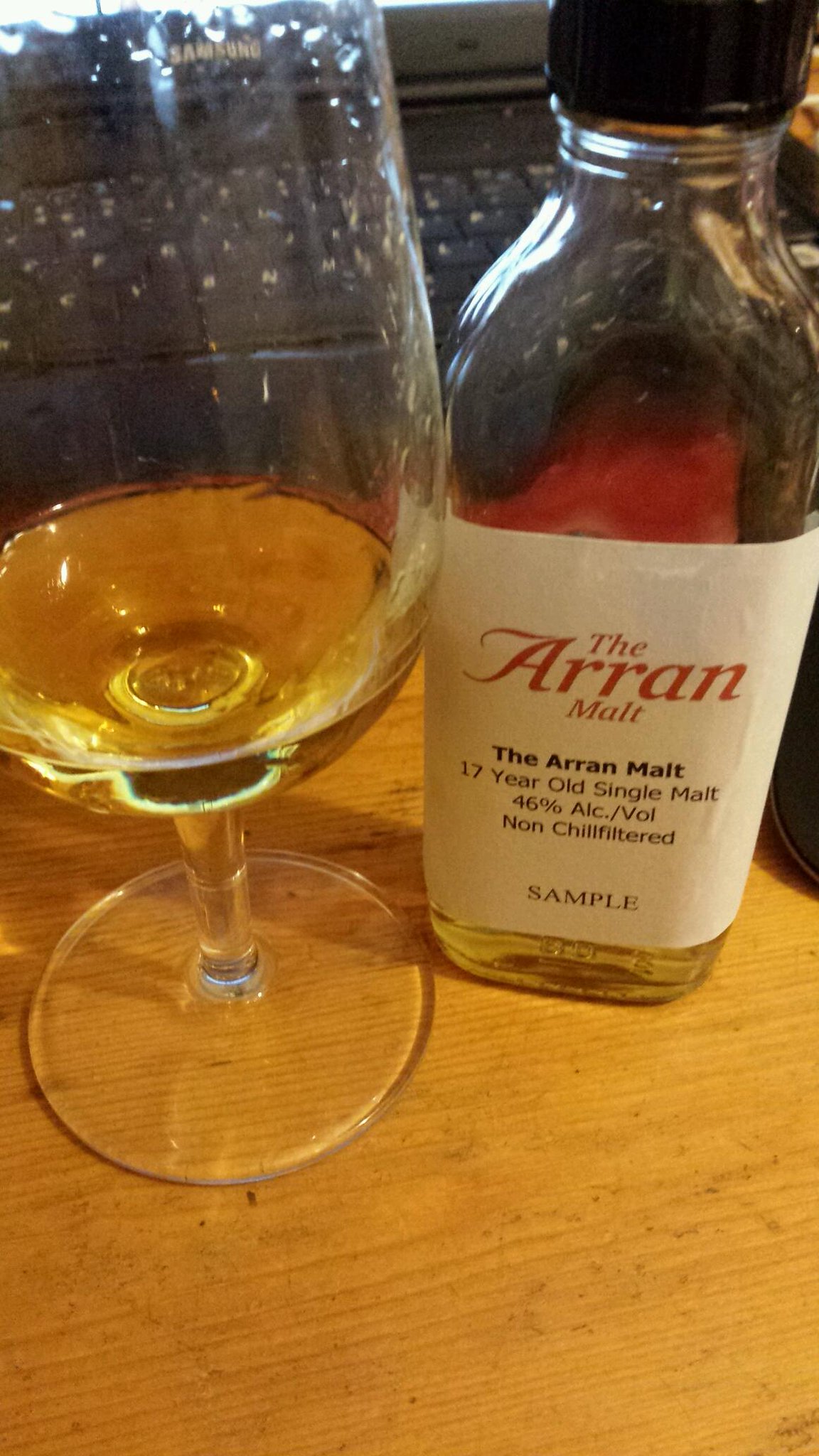
Tasting the new Arran 17 Year Old

I'm rather fond of Arran. The 10 Year Old is a good every day dram (and the bottle goes down mighty fast in my house). Some of the limited releases have been superb, such as the Peacock, and the Sleeping Warrior. I'm not so keen on the Machrie Moor  - it needs more peat - but overall I like their whiskies.

I recently tasted a single cask bottling of whisky distilled in 1996 which was outstanding, and left me thinking that Arran's plan to have an 18 Year Old as part of the core range was A Good Thing, because the mellow, rounded nature of that limited release 17 Year Old really suited the sweet toffee apple house style.

So, to this 17 Year Old, which is a limited release on the way to the Eighteen due out at some point in 2015.

The nose is sweet toffee, but with much less of the green apple note Arran usually gives me. There's a really attractive marzipan-nutty aroma. It seems a little more spirity than usual for Arran.

The palate is very rounded and mellow. Sweet syrupy apple juice, musty-dusty wood, and a little bit of the almond I found on the nose.

With water the nose opens up. Still nutty, but more macaroon or coconut, and biscuity. Not apple-y. The palate is now mouth coating and silky, very sweet and not so apple. The finish is really satisfying - lipsmacking even.

Overall, I'd rate it as Very Good Indeed.

2014-03-27

#LightOnDark

Ah, product launches, how we love you. The elaborate set dressing, the canapés, the free booze, the goodie bag, the celebrity presenter, the hash tag...

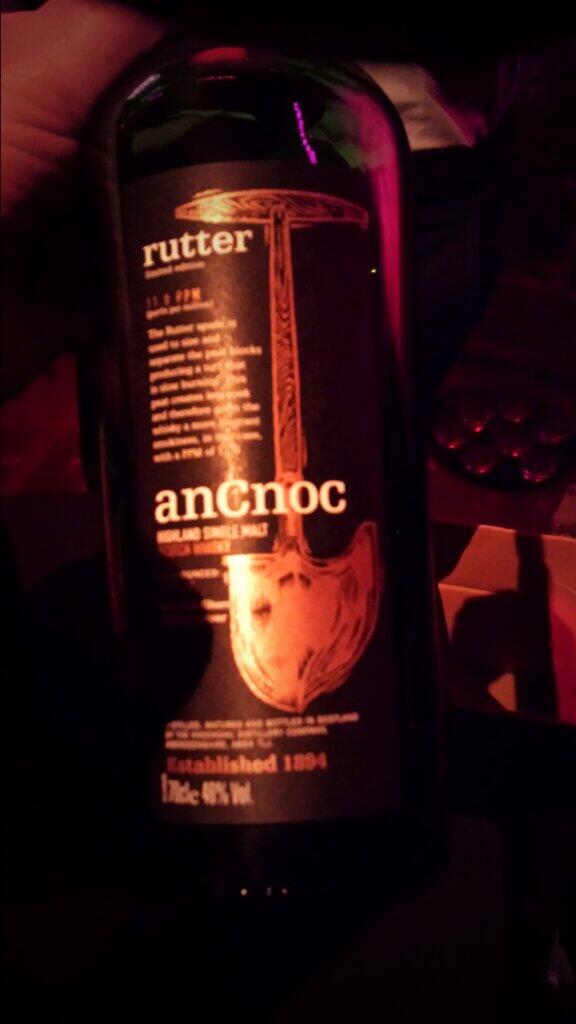
To the Arches for the release of AnCnoc's peated whiskies, Rutter, Flaughter, and Tushkar. Even before I entered the launch space I could smell the smoke. Dimly and dramatically lit, it was hardly the best environment to taste anything for the first time (especially from the big mouthed tumblers the whiskies were served in), so I bravely resolved to stuff my face with nibbles, drink whisky, and network.

AnCnoc is a sweet, light dram. It calls itself Highland, although if you ask me it's a fine example of the Speyside style. There are peated Speysiders to be found, but not many of them. AnCnoc have chosen to go for a light smoking, with the added twist that the peatiness is defined according to the level in the new make spirit, rather than, as everyone else does, by reference to the barley. Clever marketing, or merely thrawn?

I tried the Rutter with a tiny blue cheese topped biscuit served from a smoke filled glass dome. It was
delicious. I've no idea what fraction of the deliciousness was whisky-based, but delicious it was.

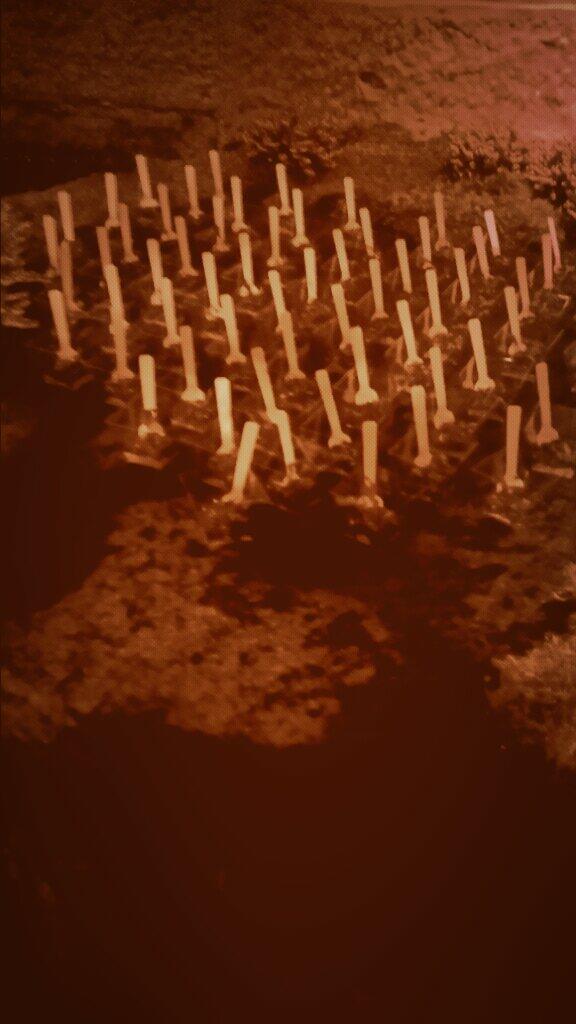
The Flaughter didn't seem to go so well with some chestnut cream filled macarons, but on the other hand the mini edible peat bogs complemented it superbly. I ate at least five.

The Tushkar? Well, it's a bit thicker or oilier than the other two, I think. And somewhat smoky.

I left, clutching my loot, having failed to network, and reflecting on the whiskies. I like the Rutter best, because it retains most AnCnoc character, combining sweet barley notes with light, dry smoke. The other two are good, but they could be from any number of distilleries.

My ratings:
  • Rutter - Very Good
  • Flaughter - Good
  • Tushkar - Good
  • #LightOnDark - Excellent
  • Edible Mini Peat Bogs - Can I Have A Full Size One Please?
    Mmmmm, edible peat bogs

2013-10-31

Some recent Glen Elgins, and a Small Lament

Selling Whisky for a living is fun, and mostly pretty straightforward. "What do you like? Oh, well this and this are pretty similar, or this is pretty special".

But when I talk to whisky enthusiasts, fellow malt heads, I often find myself pursuing a gloomier line. "You had better grab this indie Mortlach while you can. The new official releases mean all future bottles will cost twice as much"; "Of course, it's all been matured on the mainland since the early 2000s so the taste is bound to change in a year or two".

And so it is with Glen Elgin, perhaps the fruitiest of Speysiders (or at least up there in the top three with Mortlach and Glenrothes). Until 2012, according to the Malt Whisky Yearbook 2013, Glen Elgin ran two different fermentations. During the week at 76 hours, and 120 hours over the weekend.

Following the addition of three new washbacks, so as to increase capacity by 50%, this approach has been dropped, and replaced with a standard 90 hour fermentation.

The result can only be a loss of complexity, which will become apparent in the malt in a decade or so. See this article at Chemistry of the Cocktail for an excellent and detailed explanation. You heard the moaning here first.

All of this is by way of a preamble to the following Glen Elgin tasting notes. It's a Speysider I particularly like, and I do hope my prefatory grumble will maker these expressions seem all the tastier.

Gordon & Macphail Connoisseurs Choice Glen Elgin 1996, 46%
nose: fruity, like fresh chopped apples. Light lactic notes, then light woody spice, then more fruit; chocolate banana sweets.
palate: rounded & fruity. Thick fruity syrup. Adding water brings out a tangy apple note.
(tasted 2013-10-08: not rated)

Blackadder Raw Cask Glen Elgin 17yo, 57.3%
nose: spicey (ginger), malty, slightly lactic, apple-y
palate: Quite light and dry and fruity. Water sweetens it and brings out a waxy toffee apple flavour, then sweet burnt toffee with a touch of smoke.
(tasted 2013-10-28: excellent)

Milroy's Glen Elgin 17yo 1995/2013, 46%
nose: airy, fresh, sappy and sweet. Grassy, then malt loaf
palate: sweet banana malt. Woody, then bananas and oranges. Fruity, thick and sweet. Malty
(tasted 2013-10-30 as part of a tweet tasting: not rated)

2013-07-01

A couple of sherried Speysiders

Tamdhu 10 Year old was relaunched in May of this year, and on the day that I visited the distillery for the relaunch I also happened to open a bottle of Benriach 15 Year Old Pedro Ximinez Finish. 

Tamdhu was, until 2011, owned by Edrington Group, who rather neglected it. Given that they also own Highland Park and Macallan, this is understandable. What makes less sense is this: when new owners Ian Macleod Distillers were assessing their purchase, they found a decade's worth of Tamdhu filled into high quality sherry casks. Why did Edrington chose to make expensive malt whisky and then not really bother to try and sell it?

Who knows, but the decision was taken to continue this policy, despite the cost (I'm told good sherry
barrels are costing £750 each these days), so that Tamdhu could be relaunched as a premium brand.

The new bottle design certainly stands out, but what of the liquid? Well, it's pretty tasty. Tamdhu new make spirit is fruity, light, and smooth, and takes very well to active sherry casks. The sherry casks give a dryness which nicely balances the naturally sweet spirit, and adds complexity. Good Stuff.

The Benriach is more heavily sherried, but in a different style. The use of Pedro Ximinez casks gives a much sweeter edge to the whisky, although this is well balanced by a vinous tang which keeps the sweetness from being cloying. One gets the impression that the sherry casks here were all first fill, something which clearly isn't the case with the Tamdhu. One also gets the impression of a lack of integration; finishing rather than maturing the whisky. Despite that, it's still Very Good Indeed.

Sherry casks are something of a tender topic for Scotch distillers these days, and whiskies such as these two are definitely in the minority. Which leads me to conclude: if you like the sound of these; if you like sherried whiskies generally - then drink more sherry!


2011-05-07

Whisky for Grappa Drinkers

I'm sitting here enjoying three "whiskies" (lawyer-types: I know, I know, "new make spirit") from the recently re-opened Glenglassaugh distillery, which between them can't even scrape up a single year of ageing. As a grappa fan, I couldn't be happier. They all have that solventy, estery fruity nose found in fresh distillates - lovely.

The Clearac is a straightforwardly fresh, plain spirit . It definitely smells of barley, but I also found marmite and toffee pennies. It's a bit rougher than the other two. The palate is oily, sweet, a little malty, peppery, and mineralic (the sea, ozone, ammonia). The metallic finish lets it down, but still, I'd rate it Good.

Blushes  is the old lady of the bunch, with a whole six months in ex- red wine casks, which we are told come from California (as if you could tell otherwise from tasting). It is a beautiful pink gold colour, what Aunty would call rose gold, and smells very youthful still, with the same salty and ammonaical  notes found in the palate of the Clairac. On top of that there's a pippy, stalky, vinous element - tannin, I should think. Left in the glass for a while it evolves some very attractive red fruit notes, plus the classic grappa nose of honeycomb nougat. It  tastes interestingly earthy or musty, and I found a floral note too. Complex and interesting.

And so to the Peated clearac. I don't know what the Parts Per Million of Peat is for this, but they haven't stinted. And it's a fantastic interesting smokiness - dry, charred wood. If you could have smoked grappa - which would be a good thing  - you would want it to smell like this. It tastes sweet, oily, and very smoky, with more of that charred wood in the finish. Very good.

Newly opened malt whisky distilleries are always confronted with a huge cash flow problem, and have come up with various wangles to get round this. Glenglassaugh's approach is very interesting, and in the case of the 'Blushes', a definite winner. There is plenty of flavour and complexity in it, even for folk who don't usually enjoy young spirits.