At a tasting of the Glen Garioch range last night Phil Nickson of Morrison Bowmore Distillers (MBD) treated us to a preview of the latest vintage release, a 1998 distillation matured in ex wine casks, specifically Saint-Julien, a Bordeaux red wine appellation.
We started with the core expressions, the Founder's Reserve and 12 Year Old. These are drams of which I think highly, in part at least because they taste just right at 48%. This is not a common bottling strength, suggesting that it has been chosen for reasons of taste (easier to do if you only shift 19,000 cases a year rather than say 120,000 like Bowmore). Two sweet and spicy drams, good to very good.
Next was the cask strength 1999 Sherry vintage, first released last year. Very much in the bold spicy Glen Garioch style of the first two whiskies, it also showed loads of somewhat rubbery sherry, and a pile of sweet red fruits; tinned strawberries perhaps. The finish was treacly and spicy. Excellent.
Glen Garioch 1991, released in 2010, is an ex bourbon expression, dating from when Glen Garioch malted its own barley with a bit of peat in the mix. A very elegant dram (most Glen Garioch is what I'd call powerful rather than elegant), with smoky honey and coconut notes and a milky waxy finish. Very Good.
And so to the drum roll dram, the new 1998 vintage. I have to declare an interest here. I am a claret fanboy, specifically the Northern Médoc, so I may be a little biased towards this dram. It's worth noting that Saint-Julien is best known for Cabernet Sauvignon, a cask type which is also used in the assemblage for Dalmore King Alexander, a superb whisky, albeit overpriced, and in the cracking Longrow Red from Springbank.
The spice notes I found in other expressions this evening were much rounder and softer in the '98. There was a qualitative difference in the fruit character too, with definite fruit-yoghurt notes, where the other whiskies showed dried fruits and lacked the creamy, buttery note. On the other hand, there is a bit of spirit burn, which the other drams didn't have. The palate is complex, with typical Garioch spice, soft buttery-treacle notes, and a wee touch - hard to pin down - of something savoury. Most decidedly excellent.
The one caveat I have regards the price. This release, 15 years old, bottled at 48%, costs about £100. The 1991, at cask strength and 19 years old, can be had for £70. It seems to me that MBD are cashing in on the current whisky bubble.
Or perhaps I just didn't like the whisky enough. Certainly, after the tasting, three people thought it was good enough to pre-order and pay for.
By way of a bonus, Phil then treated us to a wee taster of two other expressions, the Virgin Oak and the 1986. The Virgin Oak is delicious, although it perhaps ought to be called Bourbsky or Whisbon, since white oak is such a dominant flavour (irrelevant aside: naturalists say that a typical oak tree is home to some three hundred species of other plants and animals. Is it unreasonable to call humans the three hundred and first, since the flavour of oak is so important in so many human beverages??).
The 1986 was a fine, fine drop, and made all the finer by the subtle thread of smoke running through it. Since closing their floor maltings in 1994, Glen Garioch has been made with unpeated barley. On the basis of the '86, I would call that a big fat mistake.
Showing posts with label Whisky. Show all posts
Showing posts with label Whisky. Show all posts
2014-06-05


2014-05-14
Create:Eat:Whisky
To Edinburgh for the opening session of Create:Eat:Whisky, which I'd been looking forward to ever since the anCnoc #LightOnDark event in March, because the food/whisky pairings at that event, by Jelly & Gin, were so very fine.
The venue was hidden behind a very unassuming frontage, through a wicket in a battered old yard entrance near the bottom of Leith Walk in Edinburgh. I stepped through into a dark, peat filled space, beyond which I could see smoke drifting from the dimly glowing interior.
Inside, the old Nestle factory had been equipped for fine dining, with linen table cloths and little wooden boxes containing canapés.

After a very atmospheric introductory video featuring, Wizard of Oz style, the disembodied voice of Richard Patterson doing his "Hello, How are you" schtick we tucked into said canapés, including some very fine Ayrshire Bonnet cheese, paired with Jura Elixir, a twelve year old expression. The whisky cheese combination really worked very well, especially in terms of texture (I think because Jura is a soft/mild whisky), and the fruit flavours in the pineapple chutney definitely enhanced the malt.
Jura, to me, is a decent malt, but not more than that. It's soft and easy going, and seems to suit palates not used to whisky. Perhaps this softness makes it easier to match to food. Or perhaps Jelly and Gin are geniuses. There were some outstanding flavours going on here.
Next was a wholly carnivorous serving, which looked ace but did not pass my lips. The whisky was Jura Prophecy, the heavily peated one. This is a super sweet toffee-ish dram with a goodly hit of mellow rounded smoke. Decent enough. Prophecy always reminds me that Jura likes to position itself as the whisky for every occasion. Every bottle of Jura has a kind of flavour wheel printed on the box with - would you believe it! - a Jura in every quadrant.
Third up was Origin with a pear compote. This was just delicious. The texture was right, the cooked pear brought out a similar note in the whisky, the cream I could have eaten by itself. Never before has Jura 10 Year Old tasted so good.
We finished with the Diurach's Own (a 16 Year Old) and some artisanal chocolates, which I didn't eat, preferring to take them home as tiny bribes for my family. However, I do know from other tastings I've done that Jura is the right kind of whisky for chocolates - if it were woodier the oak would seem bitter, and it's sweet enough too.
An aside: Jura emphasise (on this page) that the Diurach's Own is matured in ex Amoroso Oloroso sherry barrels. But that's just cheap Oloroso which has been sweetened, which is perhaps not the greatest recommendation.
The music (see below), subtle lighting, and props never intruded on the organoleptic experience, and the food pairings definitely made Jura taste much more interesting than it normally does. Well done to Jelly & Gin.
The venue was hidden behind a very unassuming frontage, through a wicket in a battered old yard entrance near the bottom of Leith Walk in Edinburgh. I stepped through into a dark, peat filled space, beyond which I could see smoke drifting from the dimly glowing interior.
Inside, the old Nestle factory had been equipped for fine dining, with linen table cloths and little wooden boxes containing canapés.
After a very atmospheric introductory video featuring, Wizard of Oz style, the disembodied voice of Richard Patterson doing his "Hello, How are you" schtick we tucked into said canapés, including some very fine Ayrshire Bonnet cheese, paired with Jura Elixir, a twelve year old expression. The whisky cheese combination really worked very well, especially in terms of texture (I think because Jura is a soft/mild whisky), and the fruit flavours in the pineapple chutney definitely enhanced the malt.
Jura, to me, is a decent malt, but not more than that. It's soft and easy going, and seems to suit palates not used to whisky. Perhaps this softness makes it easier to match to food. Or perhaps Jelly and Gin are geniuses. There were some outstanding flavours going on here.
Next was a wholly carnivorous serving, which looked ace but did not pass my lips. The whisky was Jura Prophecy, the heavily peated one. This is a super sweet toffee-ish dram with a goodly hit of mellow rounded smoke. Decent enough. Prophecy always reminds me that Jura likes to position itself as the whisky for every occasion. Every bottle of Jura has a kind of flavour wheel printed on the box with - would you believe it! - a Jura in every quadrant.
 |
| Pudding! |
We finished with the Diurach's Own (a 16 Year Old) and some artisanal chocolates, which I didn't eat, preferring to take them home as tiny bribes for my family. However, I do know from other tastings I've done that Jura is the right kind of whisky for chocolates - if it were woodier the oak would seem bitter, and it's sweet enough too.
An aside: Jura emphasise (on this page) that the Diurach's Own is matured in ex Amoroso Oloroso sherry barrels. But that's just cheap Oloroso which has been sweetened, which is perhaps not the greatest recommendation.
The music (see below), subtle lighting, and props never intruded on the organoleptic experience, and the food pairings definitely made Jura taste much more interesting than it normally does. Well done to Jelly & Gin.
2014-04-19
Glenglassaugh Torfa
Newly arrived this week is a no-age-statement peated whisky from Glenglassaugh distillery, Torfa (which means turf in Old Norse. I spent an entertaining twenty minutes trying to look this up. The closest I could get was torf).

Glenglassaugh, since the change of ownership in 2008 have been pursuing a strategy of releasing very old and very young whiskies - a necessity after twenty two years silent. There were a series of three new make spirit drinks, alongside such beautifully aged drams as the 26 Year Old and the 30 Year Old. The current core dram is the Evolution, which was initially released at cask strength but is now bottled at 50%.
Torfa is, like the Evolution, bottled at 50%. It's a pale whisky. The nose is fairly intense and has lots of dry smoke, with lighter notes of heather and iodine or salt. I also found a suggestion of honey.
The palate is soft and slightly oily, with honey and plenty of dry smoke, shading into a metallic warm aroma (like heating a cast iron pan with nothing in it). The palate doesn't have any of the iodic notes from the nose, which is a definite difference from Islay style peated whiskies.
With water this is a very easy drinking dram, nicely smoky, although perhaps a little simple in the finish. Best to drink it at full strength I think.
Overall I'd say this is a pretty decent whisky from Glenglassaugh. Onwards & upwards!
Glenglassaugh, since the change of ownership in 2008 have been pursuing a strategy of releasing very old and very young whiskies - a necessity after twenty two years silent. There were a series of three new make spirit drinks, alongside such beautifully aged drams as the 26 Year Old and the 30 Year Old. The current core dram is the Evolution, which was initially released at cask strength but is now bottled at 50%.
Torfa is, like the Evolution, bottled at 50%. It's a pale whisky. The nose is fairly intense and has lots of dry smoke, with lighter notes of heather and iodine or salt. I also found a suggestion of honey.
The palate is soft and slightly oily, with honey and plenty of dry smoke, shading into a metallic warm aroma (like heating a cast iron pan with nothing in it). The palate doesn't have any of the iodic notes from the nose, which is a definite difference from Islay style peated whiskies.
With water this is a very easy drinking dram, nicely smoky, although perhaps a little simple in the finish. Best to drink it at full strength I think.
Overall I'd say this is a pretty decent whisky from Glenglassaugh. Onwards & upwards!
2014-04-04
Tasting the new Arran 17 Year Old
I'm rather fond of Arran. The 10 Year Old is a good every day dram (and the bottle goes down mighty fast in my house). Some of the limited releases have been superb, such as the Peacock, and the Sleeping Warrior. I'm not so keen on the Machrie Moor - it needs more peat - but overall I like their whiskies.
I recently tasted a single cask bottling of whisky distilled in 1996 which was outstanding, and left me thinking that Arran's plan to have an 18 Year Old as part of the core range was A Good Thing, because the mellow, rounded nature of that limited release 17 Year Old really suited the sweet toffee apple house style.
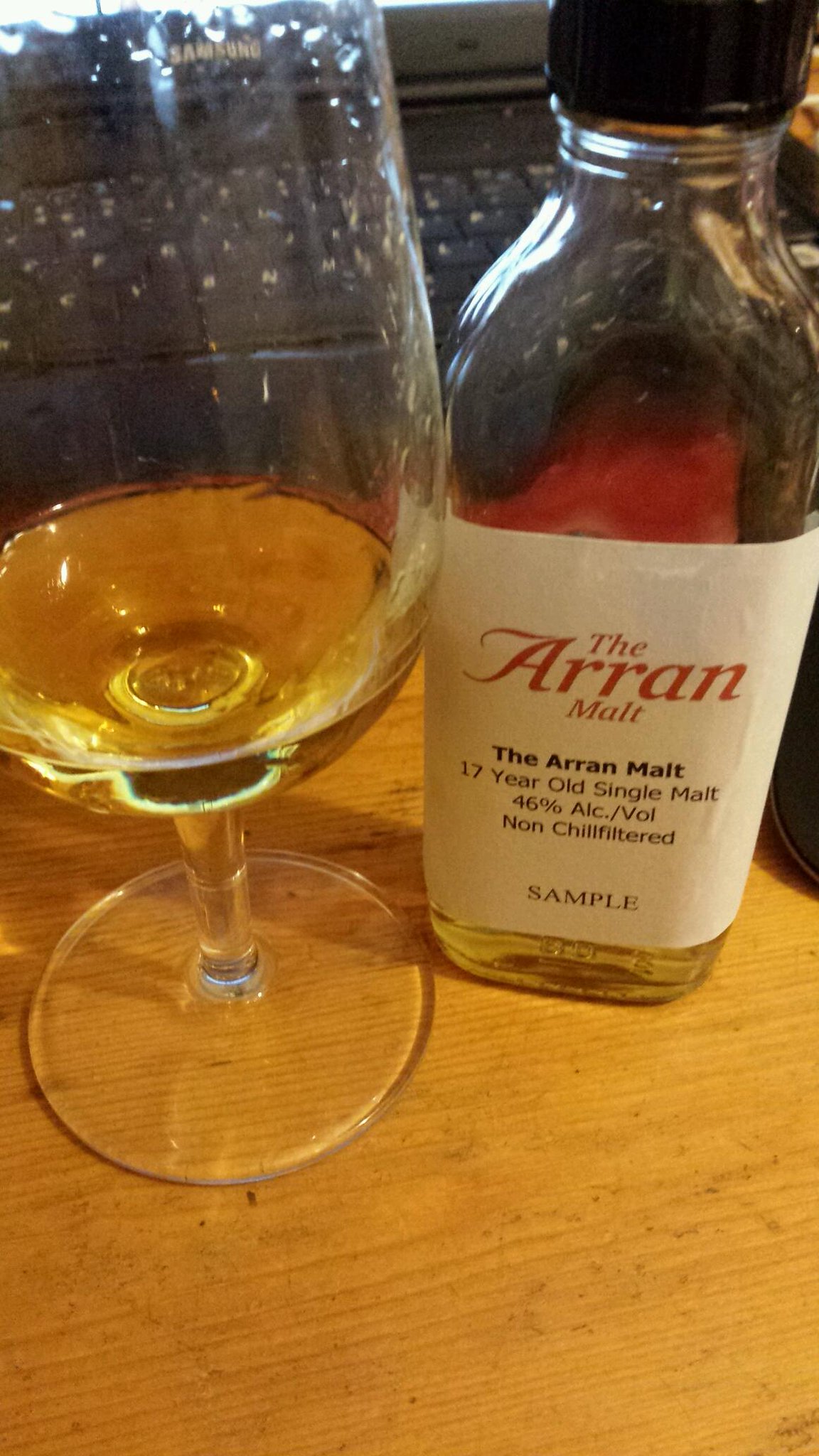 So, to this 17 Year Old, which is a limited release on the way to the Eighteen due out at some point in 2015.
The nose is sweet toffee, but with much less of the green apple note Arran usually gives me. There's a really attractive marzipan-nutty aroma. It seems a little more spirity than usual for Arran.
The palate is very rounded and mellow. Sweet syrupy apple juice, musty-dusty wood, and a little bit of the almond I found on the nose.
With water the nose opens up. Still nutty, but more macaroon or coconut, and biscuity. Not apple-y. The palate is now mouth coating and silky, very sweet and not so apple. The finish is really satisfying - lipsmacking even.
Overall, I'd rate it as Very Good Indeed.
I recently tasted a single cask bottling of whisky distilled in 1996 which was outstanding, and left me thinking that Arran's plan to have an 18 Year Old as part of the core range was A Good Thing, because the mellow, rounded nature of that limited release 17 Year Old really suited the sweet toffee apple house style.
The nose is sweet toffee, but with much less of the green apple note Arran usually gives me. There's a really attractive marzipan-nutty aroma. It seems a little more spirity than usual for Arran.
The palate is very rounded and mellow. Sweet syrupy apple juice, musty-dusty wood, and a little bit of the almond I found on the nose.
With water the nose opens up. Still nutty, but more macaroon or coconut, and biscuity. Not apple-y. The palate is now mouth coating and silky, very sweet and not so apple. The finish is really satisfying - lipsmacking even.
Overall, I'd rate it as Very Good Indeed.
2013-12-11
White Horse, bottled 1942
This is as close as I'm ever likely to get to Malt Mill. Pathetic, I know, but part of being obsessive about tasting everything the best of the best is the train-spotter tendency. And at the moment, with The Angel's Share still fairly fresh in the public consciousness, there's a chance folk might know what I'm on about.

I'm told that at this date the malt component of White Horse would have included both Malt Mill and Lagavulin, and it seems, going by the taste, that the malt content was much higher than today's bottlings, and that the whisky was peatier too.
For a whisky that has been in bottle for seventy years, this is really very smoky. Peat smoke, not wood char or coal smoke, and with some sweetness and a slight floral perfume. Very soft, of course.
The palate is silky smooth, with a big initial hit of peat, shading into cigar smoke and fruit syrup. It is light bodied except in the finish, when it gets slightly grippy, before shading into a long salt/char/sandy aftertaste.
It was a privilege to taste this fine drop, and be reminded that blends can - or could, in the past - be as good as or better than self whiskies. Excellent.
I'm told that at this date the malt component of White Horse would have included both Malt Mill and Lagavulin, and it seems, going by the taste, that the malt content was much higher than today's bottlings, and that the whisky was peatier too.
For a whisky that has been in bottle for seventy years, this is really very smoky. Peat smoke, not wood char or coal smoke, and with some sweetness and a slight floral perfume. Very soft, of course.
The palate is silky smooth, with a big initial hit of peat, shading into cigar smoke and fruit syrup. It is light bodied except in the finish, when it gets slightly grippy, before shading into a long salt/char/sandy aftertaste.
It was a privilege to taste this fine drop, and be reminded that blends can - or could, in the past - be as good as or better than self whiskies. Excellent.
2013-11-22
3D Whisky
I tasted the Cask Strength and Carry On 3D whisky the other day, and rather to my chagrin, it was very tasty.
I say that because I've always held to the old whisky maxim "Dufftown by name, duff by nature"*, but this whisky rather disproves the rule (although to be fair to my prejudice it's only partly Dufftown - the 3D refers to Dailuaine and Dalwhinnie as well).
This particular vatting of malt came about because bloggers Joel Harrison & Neil Ridley of caskstrength.net somehow persuadedThe Borg Diageo to let them have access to some casks for the latest release in their Whisky Abecediary. For that achievement alone they deserve kudos.
 So to the dram itself. (I was provided with a handy 3D tasting note sheet, but after filling it in I felt compelled to return to my notebook and write at rather more length. Perhaps you prefer the fuzzy floating 3D words.)
It's a light and floral and sweet whisky. Floral to the point of soapiness, but for me that ain't a fail. There is also a grassy note, and overall the nose is very fresh. The palate is in keeping with the nose, being light and soft. It is gently malty, and has a very tasty brown sugar note. And it's sweet, of course, thanks to the Dalwhinnie, or so it seemed to me. Altogether a very tasty vatting.
*Old whisky maxim: in other words, newly coined by me.
I say that because I've always held to the old whisky maxim "Dufftown by name, duff by nature"*, but this whisky rather disproves the rule (although to be fair to my prejudice it's only partly Dufftown - the 3D refers to Dailuaine and Dalwhinnie as well).
This particular vatting of malt came about because bloggers Joel Harrison & Neil Ridley of caskstrength.net somehow persuaded
It's a light and floral and sweet whisky. Floral to the point of soapiness, but for me that ain't a fail. There is also a grassy note, and overall the nose is very fresh. The palate is in keeping with the nose, being light and soft. It is gently malty, and has a very tasty brown sugar note. And it's sweet, of course, thanks to the Dalwhinnie, or so it seemed to me. Altogether a very tasty vatting.
*Old whisky maxim: in other words, newly coined by me.
2013-11-20
Abbey Whisky Bunnahabhain 23 Year Old
In a twitter tasting organised by the tireless Steve Rush and Abbey Whisky, my favourite dram was a Ben Nevis 16 Year Old. Rather than talk about that whisky, this post is about Bunnahabhain.
I've a soft spot for Bunna. It's rarely superb, although of course there are some limited bottlings which shine. But it soldiers on, offering a gentle, creamline toffee dram, sometimes with a touch of salt, sometimes with a little more sherry. Of course there are plenty of whiskies doing just that. Jura, Arran, Tomatin spring to mind. What sets Bunnahabhain apart is a lightness of touch, a citric, lemony note which keeps it from being bland or uninteresting.
This particular Bunnahabain is a very fine example of the style. The nose isn't intense. Rather, it is elusive, with hints of citrus, hints of salt, hints of milk or cream, in a way which draws me in rather than boring me by their faintness. The palate is a bit of a surprise at first, with a huge hit of chilli astride the honey notes, but then the salty touch and the mustiness of old casks distracts me. Water calms the chilli, leaving a light sweet fudge flavour with a warming, albeit short, finish. A nearly excellent whisky.
And that's the point, I think. If Bunna was really excellent, one would need to be a bit reverential about drinking it. But because of that nearly, you can pay attention and find something to interest you, or you can simply be dog tired and in need of a dram without having to think about it, dammit, and either way Bunnahabhain will do the job nicely.
I've a soft spot for Bunna. It's rarely superb, although of course there are some limited bottlings which shine. But it soldiers on, offering a gentle, creamline toffee dram, sometimes with a touch of salt, sometimes with a little more sherry. Of course there are plenty of whiskies doing just that. Jura, Arran, Tomatin spring to mind. What sets Bunnahabhain apart is a lightness of touch, a citric, lemony note which keeps it from being bland or uninteresting.
This particular Bunnahabain is a very fine example of the style. The nose isn't intense. Rather, it is elusive, with hints of citrus, hints of salt, hints of milk or cream, in a way which draws me in rather than boring me by their faintness. The palate is a bit of a surprise at first, with a huge hit of chilli astride the honey notes, but then the salty touch and the mustiness of old casks distracts me. Water calms the chilli, leaving a light sweet fudge flavour with a warming, albeit short, finish. A nearly excellent whisky.
And that's the point, I think. If Bunna was really excellent, one would need to be a bit reverential about drinking it. But because of that nearly, you can pay attention and find something to interest you, or you can simply be dog tired and in need of a dram without having to think about it, dammit, and either way Bunnahabhain will do the job nicely.
2013-10-31
Some recent Glen Elgins, and a Small Lament
Selling Whisky for a living is fun, and mostly pretty straightforward. "What do you like? Oh, well this and this are pretty similar, or this is pretty special".
But when I talk to whisky enthusiasts, fellow malt heads, I often find myself pursuing a gloomier line. "You had better grab this indie Mortlach while you can. The new official releases mean all future bottles will cost twice as much"; "Of course, it's all been matured on the mainland since the early 2000s so the taste is bound to change in a year or two".
And so it is with Glen Elgin, perhaps the fruitiest of Speysiders (or at least up there in the top three with Mortlach and Glenrothes). Until 2012, according to the Malt Whisky Yearbook 2013, Glen Elgin ran two different fermentations. During the week at 76 hours, and 120 hours over the weekend.
Following the addition of three new washbacks, so as to increase capacity by 50%, this approach has been dropped, and replaced with a standard 90 hour fermentation.
The result can only be a loss of complexity, which will become apparent in the malt in a decade or so. See this article at Chemistry of the Cocktail for an excellent and detailed explanation. You heard the moaning here first.
All of this is by way of a preamble to the following Glen Elgin tasting notes. It's a Speysider I particularly like, and I do hope my prefatory grumble will maker these expressions seem all the tastier.
Gordon & Macphail Connoisseurs Choice Glen Elgin 1996, 46%
nose: fruity, like fresh chopped apples. Light lactic notes, then light woody spice, then more fruit; chocolate banana sweets.
palate: rounded & fruity. Thick fruity syrup. Adding water brings out a tangy apple note.
(tasted 2013-10-08: not rated)
Blackadder Raw Cask Glen Elgin 17yo, 57.3%
nose: spicey (ginger), malty, slightly lactic, apple-y
palate: Quite light and dry and fruity. Water sweetens it and brings out a waxy toffee apple flavour, then sweet burnt toffee with a touch of smoke.
(tasted 2013-10-28: excellent)
Milroy's Glen Elgin 17yo 1995/2013, 46%
nose: airy, fresh, sappy and sweet. Grassy, then malt loaf
palate: sweet banana malt. Woody, then bananas and oranges. Fruity, thick and sweet. Malty
(tasted 2013-10-30 as part of a tweet tasting: not rated)
But when I talk to whisky enthusiasts, fellow malt heads, I often find myself pursuing a gloomier line. "You had better grab this indie Mortlach while you can. The new official releases mean all future bottles will cost twice as much"; "Of course, it's all been matured on the mainland since the early 2000s so the taste is bound to change in a year or two".
And so it is with Glen Elgin, perhaps the fruitiest of Speysiders (or at least up there in the top three with Mortlach and Glenrothes). Until 2012, according to the Malt Whisky Yearbook 2013, Glen Elgin ran two different fermentations. During the week at 76 hours, and 120 hours over the weekend.
Following the addition of three new washbacks, so as to increase capacity by 50%, this approach has been dropped, and replaced with a standard 90 hour fermentation.
The result can only be a loss of complexity, which will become apparent in the malt in a decade or so. See this article at Chemistry of the Cocktail for an excellent and detailed explanation. You heard the moaning here first.
All of this is by way of a preamble to the following Glen Elgin tasting notes. It's a Speysider I particularly like, and I do hope my prefatory grumble will maker these expressions seem all the tastier.
Gordon & Macphail Connoisseurs Choice Glen Elgin 1996, 46%
nose: fruity, like fresh chopped apples. Light lactic notes, then light woody spice, then more fruit; chocolate banana sweets.
palate: rounded & fruity. Thick fruity syrup. Adding water brings out a tangy apple note.
(tasted 2013-10-08: not rated)
Blackadder Raw Cask Glen Elgin 17yo, 57.3%
nose: spicey (ginger), malty, slightly lactic, apple-y
palate: Quite light and dry and fruity. Water sweetens it and brings out a waxy toffee apple flavour, then sweet burnt toffee with a touch of smoke.
(tasted 2013-10-28: excellent)
Milroy's Glen Elgin 17yo 1995/2013, 46%
nose: airy, fresh, sappy and sweet. Grassy, then malt loaf
palate: sweet banana malt. Woody, then bananas and oranges. Fruity, thick and sweet. Malty
(tasted 2013-10-30 as part of a tweet tasting: not rated)
2013-07-01
A couple of sherried Speysiders
Tamdhu 10 Year old was relaunched in May of this year, and on the day that I visited the distillery for the relaunch I also happened to open a bottle of Benriach 15 Year Old Pedro Ximinez Finish.

Tamdhu was, until 2011, owned by Edrington Group, who rather neglected it. Given that they also own Highland Park and Macallan, this is understandable. What makes less sense is this: when new owners Ian Macleod Distillers were assessing their purchase, they found a decade's worth of Tamdhu filled into high quality sherry casks. Why did Edrington chose to make expensive malt whisky and then not really bother to try and sell it?
Who knows, but the decision was taken to continue this policy, despite the cost (I'm told good sherry
barrels are costing £750 each these days), so that Tamdhu could be relaunched as a premium brand.
The new bottle design certainly stands out, but what of the liquid? Well, it's pretty tasty. Tamdhu new make spirit is fruity, light, and smooth, and takes very well to active sherry casks. The sherry casks give a dryness which nicely balances the naturally sweet spirit, and adds complexity. Good Stuff.
The Benriach is more heavily sherried, but in a different style. The use of Pedro Ximinez casks gives a much sweeter edge to the whisky, although this is well balanced by a vinous tang which keeps the sweetness from being cloying. One gets the impression that the sherry casks here were all first fill, something which clearly isn't the case with the Tamdhu. One also gets the impression of a lack of integration; finishing rather than maturing the whisky. Despite that, it's still Very Good Indeed.
Sherry casks are something of a tender topic for Scotch distillers these days, and whiskies such as these two are definitely in the minority. Which leads me to conclude: if you like the sound of these; if you like sherried whiskies generally - then drink more sherry!
2011-09-13
Lochside 1965
The star of an excellent tasting by Adelphi for Glasgow's Whisky Club was this rare, unusual, old single blend (that's right, single blend) from the long closed Lochside distillery.
Lochside, which operated at Montrose between 1957 and 1992, is one of a small number of distilleries to have produced both malt and grain whisky. But it's rare indeed for the two to be blended together before being put into cask.
 46 years is a very long time for a spirit to spend in cask, and it does result in aromas and flavours which younger whiskies never exhibit. Indeed even the appearance is unusual - it's as dark and viscous as a Pedro Ximinez sherry.
The nose is frankly amazing. Super sweet, but also savoury like a marinade for something about to be grilled, there is a complex array of notes from coconut to chocolate to malt to floor polish to violets. It changes too, sometimes showing the grain character, and seeming very rum-like, as old grain whiskies do. At other times it seems much maltier, with the classic christmas cake nose of a rich old Highland dram.
The palate does not disappoint. Treacle, chocolate, coconut, burnt toasty malt, creamy coffee, burnt toffee, dried vine fruits, this is a real meditation dram, but it's also very moreish. Those sweet flavours are so attractive, yet so well balanced by the bitter notes, I could drink this all night (whilst stopping occasionally to wonder at that rare violet note - something I almost never find in whisky).
A truly excellent dram, but sadly rather out of my price range at around £225. Not to worry: once tasted, never forgotten!
Lochside, which operated at Montrose between 1957 and 1992, is one of a small number of distilleries to have produced both malt and grain whisky. But it's rare indeed for the two to be blended together before being put into cask.
46 years is a very long time for a spirit to spend in cask, and it does result in aromas and flavours which younger whiskies never exhibit. Indeed even the appearance is unusual - it's as dark and viscous as a Pedro Ximinez sherry.The nose is frankly amazing. Super sweet, but also savoury like a marinade for something about to be grilled, there is a complex array of notes from coconut to chocolate to malt to floor polish to violets. It changes too, sometimes showing the grain character, and seeming very rum-like, as old grain whiskies do. At other times it seems much maltier, with the classic christmas cake nose of a rich old Highland dram.
The palate does not disappoint. Treacle, chocolate, coconut, burnt toasty malt, creamy coffee, burnt toffee, dried vine fruits, this is a real meditation dram, but it's also very moreish. Those sweet flavours are so attractive, yet so well balanced by the bitter notes, I could drink this all night (whilst stopping occasionally to wonder at that rare violet note - something I almost never find in whisky).
A truly excellent dram, but sadly rather out of my price range at around £225. Not to worry: once tasted, never forgotten!
2011-05-07
Whisky for Grappa Drinkers
I'm sitting here enjoying three "whiskies" (lawyer-types: I know, I know, "new make spirit") from the recently re-opened Glenglassaugh distillery, which between them can't even scrape up a single year of ageing. As a grappa fan, I couldn't be happier. They all have that solventy, estery fruity nose found in fresh distillates - lovely.
The Clearac is a straightforwardly fresh, plain spirit . It definitely smells of barley, but I also found marmite and toffee pennies. It's a bit rougher than the other two. The palate is oily, sweet, a little malty, peppery, and mineralic (the sea, ozone, ammonia). The metallic finish lets it down, but still, I'd rate it Good.
Blushes is the old lady of the bunch, with a whole six months in ex- red wine casks, which we are told come from California (as if you could tell otherwise from tasting). It is a beautiful pink gold colour, what Aunty would call rose gold, and smells very youthful still, with the same salty and ammonaical notes found in the palate of the Clairac. On top of that there's a pippy, stalky, vinous element - tannin, I should think. Left in the glass for a while it evolves some very attractive red fruit notes, plus the classic grappa nose of honeycomb nougat. It tastes interestingly earthy or musty, and I found a floral note too. Complex and interesting.
And so to the Peated clearac. I don't know what the Parts Per Million of Peat is for this, but they haven't stinted. And it's a fantastic interesting smokiness - dry, charred wood. If you could have smoked grappa - which would be a good thing - you would want it to smell like this. It tastes sweet, oily, and very smoky, with more of that charred wood in the finish. Very good.
Newly opened malt whisky distilleries are always confronted with a huge cash flow problem, and have come up with various wangles to get round this. Glenglassaugh's approach is very interesting, and in the case of the 'Blushes', a definite winner. There is plenty of flavour and complexity in it, even for folk who don't usually enjoy young spirits.
The Clearac is a straightforwardly fresh, plain spirit . It definitely smells of barley, but I also found marmite and toffee pennies. It's a bit rougher than the other two. The palate is oily, sweet, a little malty, peppery, and mineralic (the sea, ozone, ammonia). The metallic finish lets it down, but still, I'd rate it Good.
Blushes is the old lady of the bunch, with a whole six months in ex- red wine casks, which we are told come from California (as if you could tell otherwise from tasting). It is a beautiful pink gold colour, what Aunty would call rose gold, and smells very youthful still, with the same salty and ammonaical notes found in the palate of the Clairac. On top of that there's a pippy, stalky, vinous element - tannin, I should think. Left in the glass for a while it evolves some very attractive red fruit notes, plus the classic grappa nose of honeycomb nougat. It tastes interestingly earthy or musty, and I found a floral note too. Complex and interesting.
And so to the Peated clearac. I don't know what the Parts Per Million of Peat is for this, but they haven't stinted. And it's a fantastic interesting smokiness - dry, charred wood. If you could have smoked grappa - which would be a good thing - you would want it to smell like this. It tastes sweet, oily, and very smoky, with more of that charred wood in the finish. Very good.
Newly opened malt whisky distilleries are always confronted with a huge cash flow problem, and have come up with various wangles to get round this. Glenglassaugh's approach is very interesting, and in the case of the 'Blushes', a definite winner. There is plenty of flavour and complexity in it, even for folk who don't usually enjoy young spirits.
2011-01-30
Penderyn, Bunnahabhain, Machrie Moor
Lightly peated whiskies are a tricky business.
Big bold peated malts are a great style, shouldering their way across your palate with their salt and smoke and earthiness, but at times they can leave you feeling like a crockery salesman in Pamplona.
Speysiders or Highlanders would say they have a touch of peat in them (from the water), before changing the subject to honey or sherry or such like.
Lightly peated malts fall somewhere between these two stools, landing in an awkward area which not many whiskies can comfortably inhabit.
Hence the great fascination of Bunnahabhain. Good Bunna is one of life's pleasures. Bad Bunna, as Oz Clarke says of bad Burgundy, leaves you discontentedly fingering your wallet.
So where do Penderyn Peated and the new Isle of Arran Machrie Moor fall?
My first impression is that they are mood whiskies - sometimes fantastic and other times so-so. This isn't a criticism, it's true of most drams.
The Isle of Arran Machrie Moor has a quietly attractive nose, starting with toffee and then letting out a little puff of smoke, nothing ferocious. To taste it is nicely oily, with a lemony spicy sweetness and a fair bit of dry smoke - dried pine twigs rather than big bonfires. It dries out in the finish, leaving the smoke behind to remind you to take another sip (yes, it is rather moreish).
The Penderyn Peated is less intense to smell, with something like mint tea and a sort of fresh smoke - maybe smoke on a windy day. Tasting it reveals a herbaceous edge to the smoke, like throwing thyme on a barbeque, and then it gets all hot and peppery in the finish.
After these two the Bunnahabhain 12 year old seems pretty mild mannered. Sweet, malty or cerealy to begin, becoming really as sweet as a toffee penny. Tasting it, the body is much fuller than the other two, and I can't really see any smoke in there at all. Perhaps the peat is doing the Highland trick of broadening the malt, but behind the scenes, so to speak.
Both of the newcomers have been growing on me with repeated tastings. But (it's a small but), my overall impression, as has been the case with the standard release from each distillery, is that, while good, they'll be better when they are older. I'm really enjoying the standard Arran 10 just now, which has a decent breadth that younger releases lacked, and I'd love to taste a smoky version of that. So the Penderyn Peated is pretty good, 3; the Isle of Arran Machrie Moor is really rather good, 3++; and good old Bunna (tonight, at least) is comfy and reliable, 3.
Big bold peated malts are a great style, shouldering their way across your palate with their salt and smoke and earthiness, but at times they can leave you feeling like a crockery salesman in Pamplona.
Speysiders or Highlanders would say they have a touch of peat in them (from the water), before changing the subject to honey or sherry or such like.
Lightly peated malts fall somewhere between these two stools, landing in an awkward area which not many whiskies can comfortably inhabit.
Hence the great fascination of Bunnahabhain. Good Bunna is one of life's pleasures. Bad Bunna, as Oz Clarke says of bad Burgundy, leaves you discontentedly fingering your wallet.
So where do Penderyn Peated and the new Isle of Arran Machrie Moor fall?
My first impression is that they are mood whiskies - sometimes fantastic and other times so-so. This isn't a criticism, it's true of most drams.
The Isle of Arran Machrie Moor has a quietly attractive nose, starting with toffee and then letting out a little puff of smoke, nothing ferocious. To taste it is nicely oily, with a lemony spicy sweetness and a fair bit of dry smoke - dried pine twigs rather than big bonfires. It dries out in the finish, leaving the smoke behind to remind you to take another sip (yes, it is rather moreish).
The Penderyn Peated is less intense to smell, with something like mint tea and a sort of fresh smoke - maybe smoke on a windy day. Tasting it reveals a herbaceous edge to the smoke, like throwing thyme on a barbeque, and then it gets all hot and peppery in the finish.
After these two the Bunnahabhain 12 year old seems pretty mild mannered. Sweet, malty or cerealy to begin, becoming really as sweet as a toffee penny. Tasting it, the body is much fuller than the other two, and I can't really see any smoke in there at all. Perhaps the peat is doing the Highland trick of broadening the malt, but behind the scenes, so to speak.
Both of the newcomers have been growing on me with repeated tastings. But (it's a small but), my overall impression, as has been the case with the standard release from each distillery, is that, while good, they'll be better when they are older. I'm really enjoying the standard Arran 10 just now, which has a decent breadth that younger releases lacked, and I'd love to taste a smoky version of that. So the Penderyn Peated is pretty good, 3; the Isle of Arran Machrie Moor is really rather good, 3++; and good old Bunna (tonight, at least) is comfy and reliable, 3.
2011-01-10
A Penderyn cyber-tasting
With a view to synchronising our palates, SF and I (with expert kibitzing provided by TallAsAVan) conducted a tasting of Penderyn whiskies at a distance of four hundred miles, using Skype. This worked really well, except that I found myself rather bellowing.
I'm in two minds about what Penderyn do. They have a weird setup which seems to be the bastard offspring of a pot still and a column still. And they distill to 92% ABV. In other words, they are making something like grain spirit, and relying on the casks to impart a much higher proportion of flavour than normal. On the one hand, selecting high-quality casks to finish your spirit can produce lovely whiskies (think Compass Box), but on the other, what about terroir, typicity?
We tasted the Madeira, Sherrywood, and Peated finishes, and while they are all what I'd call restrained whiskies, I enjoyed them. There's a common theme of tangy fruit; oranges or apricots, and often with a lick of chocolate to them, as well as the same minty note I've found in the Saint George English whisky - the same mintiness you find in Glenkinchie 12 year old.
The Madeira finish is Penderyn's standard expression. No age statement, but it doesn't taste young (no new make spirit character I can see). Instead it tastes smooth, light, and fruity - definitely chocolate oranges. Good to Excellent.
The Sherrywood is the woodiest of the three. On top of the orange-to-apricot flavour, there's a generous handful of dried fruit and nuts, and a surprising, but very tasty, layer of butterscotch. Good.
The Penderyn Peated is drier than tonight's other drams. It has a nice dry smoke to it, with dry earth and a smell of sheds. It tastes of the seaside, but the sweet chocolate orange character comes through nicely. Also Good.
Tasting via Skype was good fun - much laughter - and certainly easier than tweeting, if you are trying to take notes too. I'd recommend you try it. Just don't spill anything into your keyboard...
I'm in two minds about what Penderyn do. They have a weird setup which seems to be the bastard offspring of a pot still and a column still. And they distill to 92% ABV. In other words, they are making something like grain spirit, and relying on the casks to impart a much higher proportion of flavour than normal. On the one hand, selecting high-quality casks to finish your spirit can produce lovely whiskies (think Compass Box), but on the other, what about terroir, typicity?
We tasted the Madeira, Sherrywood, and Peated finishes, and while they are all what I'd call restrained whiskies, I enjoyed them. There's a common theme of tangy fruit; oranges or apricots, and often with a lick of chocolate to them, as well as the same minty note I've found in the Saint George English whisky - the same mintiness you find in Glenkinchie 12 year old.
The Madeira finish is Penderyn's standard expression. No age statement, but it doesn't taste young (no new make spirit character I can see). Instead it tastes smooth, light, and fruity - definitely chocolate oranges. Good to Excellent.
The Sherrywood is the woodiest of the three. On top of the orange-to-apricot flavour, there's a generous handful of dried fruit and nuts, and a surprising, but very tasty, layer of butterscotch. Good.
The Penderyn Peated is drier than tonight's other drams. It has a nice dry smoke to it, with dry earth and a smell of sheds. It tastes of the seaside, but the sweet chocolate orange character comes through nicely. Also Good.
Tasting via Skype was good fun - much laughter - and certainly easier than tweeting, if you are trying to take notes too. I'd recommend you try it. Just don't spill anything into your keyboard...
2010-11-13
Glasgow's Whisky Festival
A lovely afternoon, spent in the Arches, sampling my way around some very fine whiskies. The inaugural Glasgow's Whisky Festival was a great opportunity to taste some obscure, rare, hard to get or, frankly, unaffordable drams (fifty year old Speyside anyone?).
As it happens, my favourite whisky of the day was neither old or ridiculously expensive.
The Creative Whisky Company's 4-year old Bunnahabhain was the kind of drink which makes me laugh out loud when I smell it. This doesn't happen often, but it's one of the reasons why booze remains so endlessly fascinating.
Matured in a bourbon cask from 2005 to 2010, this malt is powerful, natural cask strength stuff. The initial nose smells exactly like the dentists, but then a well balanced range of citrus, brine, and spicy wood notes come through.
I had to add water to be able to taste it (57.7% alcohol you see), but when I did I found it to be a lovely smooth salty whisky, with a strong nutty note, like brazil nut toffee. The finish was long and salty. Altogether a fantastic Islay malt, probably the best Bunnahabhain I've yet tasted, and my malt of the Festival.
(Malt of the Festival = 4-5)
As it happens, my favourite whisky of the day was neither old or ridiculously expensive.
The Creative Whisky Company's 4-year old Bunnahabhain was the kind of drink which makes me laugh out loud when I smell it. This doesn't happen often, but it's one of the reasons why booze remains so endlessly fascinating.
Matured in a bourbon cask from 2005 to 2010, this malt is powerful, natural cask strength stuff. The initial nose smells exactly like the dentists, but then a well balanced range of citrus, brine, and spicy wood notes come through.
I had to add water to be able to taste it (57.7% alcohol you see), but when I did I found it to be a lovely smooth salty whisky, with a strong nutty note, like brazil nut toffee. The finish was long and salty. Altogether a fantastic Islay malt, probably the best Bunnahabhain I've yet tasted, and my malt of the Festival.
(Malt of the Festival = 4-5)
2010-08-29
Aberlour a Go-go
Another entertaining tasting at the Bothy, this time, a Sunday afternoon whisky school, with some very interesting food matching going on.
Dalwhinnie 15yo was rather excellent tasted with honeycomb nougat. Ardbeg 10yo went surprisingly well with a mildish remoulade; the horseradish wasn't overly fiery, and the creamy dressing pulled everything together nicely. But the culinary star of the day was Aberlour A'Bunadh batch 31.
A'Bunadh is a true sherry monster, in the best way possible. This batch seems particularly wine-y and fresh - it reminds you that sherry is a wine, and sometimes a rather fruity one. But more than that, and always, A'Bunadh tastes of cherries; sweet red cherries, not the black ones.
So served with a big fat cherry that had been dipped in dark chocolate, the Aberlour was very heaven (very heaven = 5).
Dalwhinnie 15yo was rather excellent tasted with honeycomb nougat. Ardbeg 10yo went surprisingly well with a mildish remoulade; the horseradish wasn't overly fiery, and the creamy dressing pulled everything together nicely. But the culinary star of the day was Aberlour A'Bunadh batch 31.
A'Bunadh is a true sherry monster, in the best way possible. This batch seems particularly wine-y and fresh - it reminds you that sherry is a wine, and sometimes a rather fruity one. But more than that, and always, A'Bunadh tastes of cherries; sweet red cherries, not the black ones.
So served with a big fat cherry that had been dipped in dark chocolate, the Aberlour was very heaven (very heaven = 5).
2010-07-12
Where's the Sherry?
Well who'd have thought it? Mortlach is a fruity whisky.
I tasted this particular bottling (Cadenhead Mortlach 14yo 1992/2006, 46%) blind, and never in a decade would I have picked Mortlach as the source, because, to repeat my initial question, where's the sherry?
Actually, no, don't tell me. Leave it in Spain. Mortlach without sherry influence is a lovely dram, all green apples and highland toffee and angelica and very, very fresh. Also, light and watery - not lacking intensity of flavour, I mean the texture is watery. A breakfast Mortlach, or, (for the more puritanical) an aperitif.
It does say on the bottle that this whisky has been matured in sherry casks, but they must have been very old, for there really isn't any sort of influence on the flavour. And a good thing too, say I. Mortlach 14yo, a very good thing indeed, 4+.
I tasted this particular bottling (Cadenhead Mortlach 14yo 1992/2006, 46%) blind, and never in a decade would I have picked Mortlach as the source, because, to repeat my initial question, where's the sherry?
Actually, no, don't tell me. Leave it in Spain. Mortlach without sherry influence is a lovely dram, all green apples and highland toffee and angelica and very, very fresh. Also, light and watery - not lacking intensity of flavour, I mean the texture is watery. A breakfast Mortlach, or, (for the more puritanical) an aperitif.
It does say on the bottle that this whisky has been matured in sherry casks, but they must have been very old, for there really isn't any sort of influence on the flavour. And a good thing too, say I. Mortlach 14yo, a very good thing indeed, 4+.
2010-06-28
Whither Cragganmore?
I'm not the only one, I think, who has the idea that Cragganmore isn't what it was ten years ago.
My - admittedly not very systematic - impression was that the spirit had become lighter and less intense. Obviously, this called for a taste test, so I rummaged about the interwebs and came up with a Gordon & MacPhail 1969 Cragganmore from the old brown label Connoiseurs Choice series. Conveniently this was bottled at the same 40% as the Official 12 Year Old I compared it with (which was bottled around 2010).
Neither of these is an outstanding dram, although they are both good single malts. The two were pretty similar, unsurprisingly, but I did find that the older bottling had a little more complexity. It seemed to have rather more woody notes, in an elegant sort of a way, and I was pretty sure that there was a touch of smoke about it (although this could be a barrel effect I suppose). On the whole, there wasn't a great deal between them.
In conclusion, I have to say case not proven. And I hereby resolve to drink whisky with a little less cynicism in future.
My - admittedly not very systematic - impression was that the spirit had become lighter and less intense. Obviously, this called for a taste test, so I rummaged about the interwebs and came up with a Gordon & MacPhail 1969 Cragganmore from the old brown label Connoiseurs Choice series. Conveniently this was bottled at the same 40% as the Official 12 Year Old I compared it with (which was bottled around 2010).
Neither of these is an outstanding dram, although they are both good single malts. The two were pretty similar, unsurprisingly, but I did find that the older bottling had a little more complexity. It seemed to have rather more woody notes, in an elegant sort of a way, and I was pretty sure that there was a touch of smoke about it (although this could be a barrel effect I suppose). On the whole, there wasn't a great deal between them.
In conclusion, I have to say case not proven. And I hereby resolve to drink whisky with a little less cynicism in future.
2010-05-07
Off to Alloa...
...for a charity fundraising whisky tasting. The six whiskies were all donated, so there was no theme, but some interesting contrasts arose anyway.
Tullibardine was mothballed in 1995 and did not produce whisky again until 2003, when they became independent. They have approached the problem of this gap in production (which leaves them unable to offer a ten year old whisky until 2013) and made a virtue of necessity by presenting the whisky as a Bourbon Cask Edition, which is rather like Hovis offering their bread as the Yeasted Edition. It's a light easy whisky which reminded me of Auchentoshan 10yo, being spirity and sweetly floral. Good, 3+.
Tormore 12yo and Dufftown 12yo (sorry Diageo, Singleton of Dufftown) were both very easy Speysides in the toffee-ish mode, although I did see an interesting herbaceous aftertaste in the Tormore. Bunnahabhain 12yo was also an easy malt, and tonight it seemed maltier than usual for an Islay whisky.
Lagavulin 16yo and Laphroaig Quarter Cask were a fine pairing. The Lagavulin (the oldest standard release of any malt?) is all smoke and brine and intense oily saltiness, but the Quarter Cask has reined in the usual Laphroaig TCP aroma somewhat, perhaps allowing the whisky to appeal to a wider audience. The texture, too, is easier -smoother- than the ten year old. Both these whiskies I rated as excellent, 4 to 4+.
The best description of the night, about the Lagavulin, was, "like a mixture of amyl nitrate, ether and methylated spirits", from a chap who claims that he fuels model airplanes with such a mixture.
Tullibardine was mothballed in 1995 and did not produce whisky again until 2003, when they became independent. They have approached the problem of this gap in production (which leaves them unable to offer a ten year old whisky until 2013) and made a virtue of necessity by presenting the whisky as a Bourbon Cask Edition, which is rather like Hovis offering their bread as the Yeasted Edition. It's a light easy whisky which reminded me of Auchentoshan 10yo, being spirity and sweetly floral. Good, 3+.
Tormore 12yo and Dufftown 12yo (sorry Diageo, Singleton of Dufftown) were both very easy Speysides in the toffee-ish mode, although I did see an interesting herbaceous aftertaste in the Tormore. Bunnahabhain 12yo was also an easy malt, and tonight it seemed maltier than usual for an Islay whisky.
Lagavulin 16yo and Laphroaig Quarter Cask were a fine pairing. The Lagavulin (the oldest standard release of any malt?) is all smoke and brine and intense oily saltiness, but the Quarter Cask has reined in the usual Laphroaig TCP aroma somewhat, perhaps allowing the whisky to appeal to a wider audience. The texture, too, is easier -smoother- than the ten year old. Both these whiskies I rated as excellent, 4 to 4+.
The best description of the night, about the Lagavulin, was, "like a mixture of amyl nitrate, ether and methylated spirits", from a chap who claims that he fuels model airplanes with such a mixture.
2010-03-17
I'm a drink you don't meet every day
It's a malt whisky - except it ain't, yet. Abhainn Dearg, one of the new breed of craft distlleries (trans: small, hand-made, local), have just released a limited quantity of spirit. Legally, it won't be whisky until late in 2011.
I tasted it at McSorley's, straight from a 30 litre oloroso sherry cask. "Spirit of Lewis" is a complex malt, with an interesting back and forth of flavours. The texture is light and airy - not watery, but airy, like good Condrieu. It is also very like grappa, very spirity, but there is also a big whack of honey and nougat, and a little milk chocolate.
The palate is delicate. There's green leafy, cigar, seashells, and plenty of sweetness. With water it moves from grappa towards a malty whisky character. I couldn't find any peat in it. In conclusion it is a good one (good one = 4+), and already very drinkable, especially compared with other new make spirits I have tried.
I tried to describe it to someone, and they said, "so it's like Jura then", but I think a better comparison, assuming a few years in cask, would be to Abunadh.
I tasted it at McSorley's, straight from a 30 litre oloroso sherry cask. "Spirit of Lewis" is a complex malt, with an interesting back and forth of flavours. The texture is light and airy - not watery, but airy, like good Condrieu. It is also very like grappa, very spirity, but there is also a big whack of honey and nougat, and a little milk chocolate.
The palate is delicate. There's green leafy, cigar, seashells, and plenty of sweetness. With water it moves from grappa towards a malty whisky character. I couldn't find any peat in it. In conclusion it is a good one (good one = 4+), and already very drinkable, especially compared with other new make spirits I have tried.
I tried to describe it to someone, and they said, "so it's like Jura then", but I think a better comparison, assuming a few years in cask, would be to Abunadh.
2007-03-21
Tonight's Tasting Brought to you by the Letter B
Small Island Boy was up to his tricks again, this time with some brilliant whisky. He gave us two Balvenies versus two Bruichladdichs (kind of) and then finished off with that ne plus ultra for whisky-twitchers, a bottling from a deceased distillery.
It was a hellish cold night in Partick, but after the tasting I found myself to be quite comfortable sans jacket. More to the point, all the next day I was clad two layers lighter than usual saying to myself from within my cereal glow, "uisge beatha truly is the water of life" - I really have to tell you, whisky fires you up and gets you going, it fires and inspires me, all hail the acrospire!
Whoops... slightly carried away there. For your convenience: acrospire defined. Things not any clearer? Just ask SIB, for he is the Man Who Knows.
The whiskies:
Bruichladdich 1993 recioto cask finish versus Balvenie 1993 Port wood
I liked the nosefeel of the Laddie - kinda velvety - but the Balvenie won this bout, by virtue of its relaxed mellowtude and digestive biscuit finish.
Port Charlotte 5 year old versus Balvenie 14 year old roasted malt
I suppose the malt one might imagine regularly sipping, of all tonight's offerings, would be this Balvenie, for its easy character, and especially for the hint of honey-dipped cigars it occasionally offers. Yet the winner here was the PC5. Freshness, that full on Islay Wow! character that first drew me to malt whisky, or just the complexity in the glass. Or all three...
the Brora 30 year old scored highest for the night (4 - 5: excellent - astonishing) and brought me a new organoleptic experience : the scent of lilies. Only once, and fleetingly, but lilies. From malt whisky. There were other things, perhaps less desirable. Cowbyres. Sunwarmed animals. Seabirds. Leaves - mouldering ones. Caboc (also know as 'Here, this butter is past the sell by date. I know! Let's repackage it as cheese')
A great night. Thanks, SIB. Thanks, 'B'.
It was a hellish cold night in Partick, but after the tasting I found myself to be quite comfortable sans jacket. More to the point, all the next day I was clad two layers lighter than usual saying to myself from within my cereal glow, "uisge beatha truly is the water of life" - I really have to tell you, whisky fires you up and gets you going, it fires and inspires me, all hail the acrospire!
Whoops... slightly carried away there. For your convenience: acrospire defined. Things not any clearer? Just ask SIB, for he is the Man Who Knows.
The whiskies:
Bruichladdich 1993 recioto cask finish versus Balvenie 1993 Port wood
I liked the nosefeel of the Laddie - kinda velvety - but the Balvenie won this bout, by virtue of its relaxed mellowtude and digestive biscuit finish.
Port Charlotte 5 year old versus Balvenie 14 year old roasted malt
I suppose the malt one might imagine regularly sipping, of all tonight's offerings, would be this Balvenie, for its easy character, and especially for the hint of honey-dipped cigars it occasionally offers. Yet the winner here was the PC5. Freshness, that full on Islay Wow! character that first drew me to malt whisky, or just the complexity in the glass. Or all three...
the Brora 30 year old scored highest for the night (4 - 5: excellent - astonishing) and brought me a new organoleptic experience : the scent of lilies. Only once, and fleetingly, but lilies. From malt whisky. There were other things, perhaps less desirable. Cowbyres. Sunwarmed animals. Seabirds. Leaves - mouldering ones. Caboc (also know as 'Here, this butter is past the sell by date. I know! Let's repackage it as cheese')
A great night. Thanks, SIB. Thanks, 'B'.
Subscribe to:
Posts (Atom)